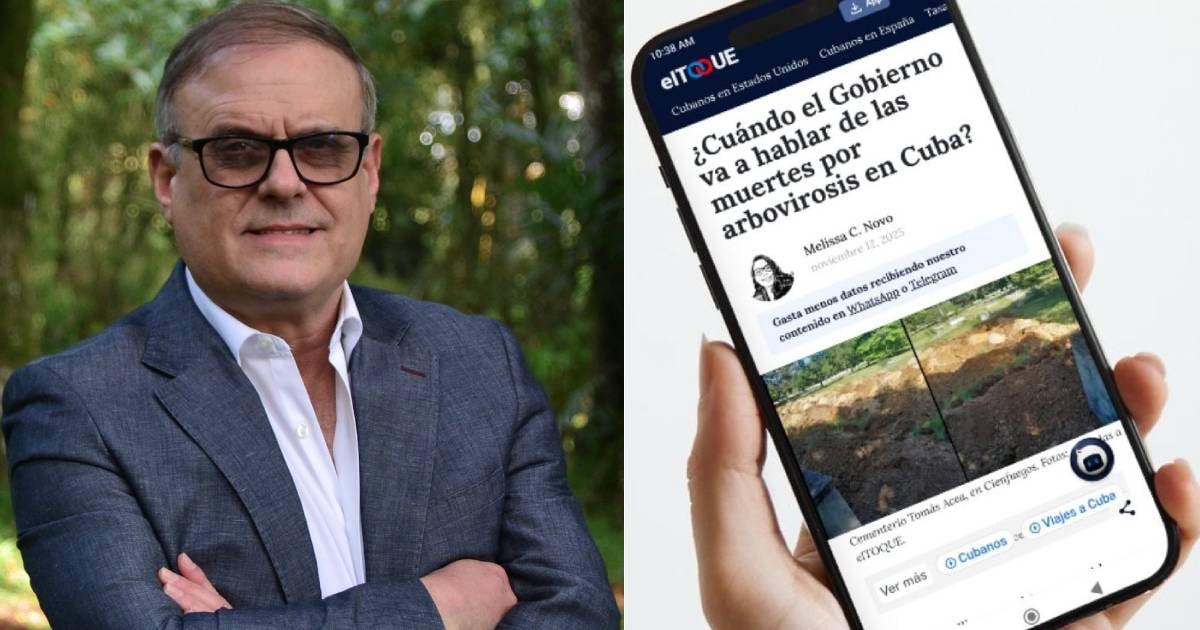
Amidst a fierce smear campaign launched by the Cuban regime against the independent media outlet El Toque this week, Cuban economist Mauricio de Miranda Parrondo has responded with a powerful message on Facebook. He urged the cessation of deceiving the Cuban people and directly blamed the political powers for the country's economic collapse.
The attack began following reports from Razones de Cuba and the regime's spokesperson Humberto López, who accused El Toque of "financial terrorism," "currency trafficking," "tax evasion," and allegedly manipulating the informal dollar exchange rate to "depress the population's income."
This narrative has been echoed by ministers, the Central Bank, Foreign Minister Bruno Rodríguez, and even President Miguel Díaz-Canel, all without providing verifiable evidence.
The Real Causes of Cuba's Economic Woes
De Miranda dismissed this strategy as merely another attempt to deflect responsibility. In a detailed post, he debunked the official claim that El Toque is causing the devaluation of the Cuban peso, asserting that "no publication can destabilize an economy and, certainly, not impoverish a country. Don't buy into fairy tales."
According to De Miranda, the poverty suffocating Cubans stems from much deeper, long-standing issues such as decades of failed economic policies, political voluntarism, productive destruction, and the chronic inability of those in power.
He also acknowledged the impact of U.S. sanctions, which he recognizes as real, but argues that the regime uses them as a scapegoat to avoid addressing internal problems.
Challenging the Regime's Evasion Tactics
The economist devoted a significant portion of his message to a series of pointed questions aimed directly at the ruling elite: Who nationalized everything without productive capacity? Who dismantled fruit orchards and destroyed livestock? Who decided to close sugar mills? Who dollarized consumption without dollarizing income? Who maintains a military and financial conglomerate outside citizen control?
The implicit, yet clear answer is that it was not digital platforms or independent economists but the Cuban state itself.
"Enough with deceiving the Cuban people. Enough with finding 'scapegoats' to hide the negligence, incompetence, and ineptitude of a bureaucracy that only cares about its survival," De Miranda declared.
Demands for Monetary Reform
One of the most striking parts of his message was directed at the Central Bank of Cuba, which joined in the accusations against El Toque. He challenged them by saying, "Is the Central Bank the monetary authority? Very well, then fulfill your function. You should not issue money without backing under the government's demands."
The economist emphasized that the only way to avoid reliance on the informal market, which the government attempts to blame on El Toque, is to establish a formal, legal, and transparent currency exchange market, free from manipulation by "incompetent" bureaucrats.
Call for Genuine Solutions
In an unusually emotive tone, De Miranda acknowledged his writing came from a place of indignation: "One can get really upset... Old Havana combined with La Lenin can be a very strong mix," he remarked, referring to his own background.
He concluded with a direct warning to those in power: "The country needs solutions, not complaints, not blaming others... And if you are unable, step aside. Let society manage itself before it's too late."
A Campaign Amidst Crisis
The accusations against El Toque come at a crucial moment, with rampant inflation, power outages, shortages, and a plummeting national currency further exacerbated by the devastating passage of Hurricane Melissa in the eastern part of the country.
Yet, instead of taking responsibility for the crisis, the regime has sought to channel the outrage towards a media outlet that merely publishes the informal market rate, which millions of Cubans rely on daily in the absence of a reliable official reference.
De Miranda's response, widely shared on social media, reveals a sentiment that has become common among Cubans both on and off the island, where no one believes in foreign scapegoats, unproven conspiracies, or propaganda attempting to cover up decades of economic mistakes.
Understanding Cuba's Economic Challenges
What accusations were made against El Toque by the Cuban regime?
El Toque was accused by the Cuban regime of "financial terrorism," "currency trafficking," "tax evasion," and allegedly manipulating the informal dollar exchange rate to depress the population's income.
How does Mauricio de Miranda perceive the economic situation in Cuba?
Mauricio de Miranda believes the economic collapse in Cuba is due to deep-rooted issues such as failed economic policies, political voluntarism, and the chronic incompetence of those in power, rather than the actions of El Toque.
What solution does De Miranda propose for Cuba's economic problems?
De Miranda suggests the establishment of a formal, legal, and transparent currency exchange market, not manipulated by bureaucrats, to avoid dependence on the informal market.