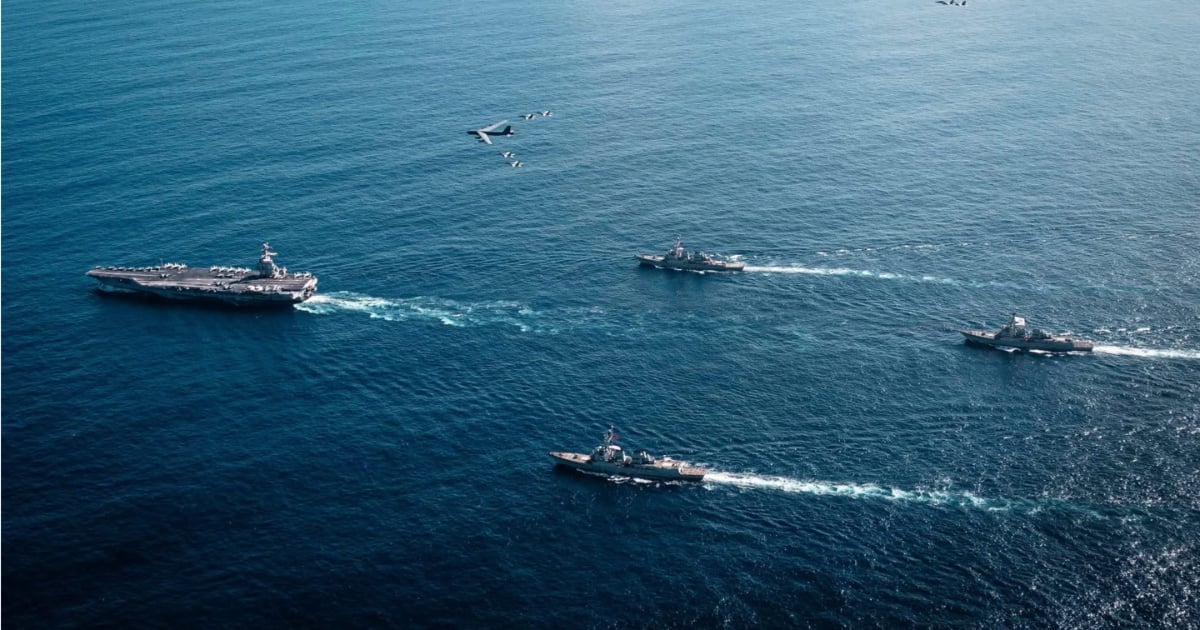
The USS Gerald R. Ford, the largest and most formidable aircraft carrier of the United States, made its entrance into Caribbean waters this past Sunday. This move, aimed at addressing "transnational threats" in the area, occurs amidst Washington's increasing pressure on Venezuela, as noted by Admiral Alvin Holsey, head of the U.S. Southern Command.
According to a statement released by the Southern Command's own portal, Admiral Holsey emphasized the importance of "a steadfast commitment and precise utilization of our forces" to counteract transnational threats that jeopardize regional stability.
The deployment of the USS Gerald R. Ford's strike group follows directives from U.S. Secretary of Defense Pete Hegseth and aligns with President Donald Trump's strategy to dismantle transnational criminal organizations and combat narcoterrorists, all in the name of safeguarding the security of the United States and the Western Hemisphere.
Reinforcing U.S. Military Presence in the Region
Holsey described this operation as "a critical step" in bolstering the United States' ability to protect both the Western Hemisphere and domestic security through an enhanced military presence within the Southern Command's jurisdiction.
The aircraft carrier is set to join the 22nd Expeditionary Unit aboard the amphibious assault ship USS Iwo Jima, as part of a military initiative called "Southern Spear." This campaign is a component of Washington's ongoing battle against drug trafficking originating from Latin America and coincides with rising tensions with the Venezuelan government.
The USS Gerald R. Ford: A Maritime Powerhouse
Described by the U.S. Navy as the world's "most capable, versatile, and lethal combat platform," the USS Gerald R. Ford can operate with around 4,500 personnel and accommodate up to 70 aircraft, including fighters, helicopters, and other aerial assets.
With a length exceeding 1,100 feet and nuclear propulsion, the carrier features an electromagnetic catapult system for aircraft launches, advanced radar systems, and reactors that allow for continuous operation over extended periods.
During its testing phase in 2021, the Gerald R. Ford underwent three high-powered underwater explosions, known as "full ship shock trials," designed to verify its ability to withstand extreme impacts and maintain combat operations.
U.S. Naval Forces on High Alert
The Ford's presence in the Caribbean coincides with U.S. naval movements near Trinidad and Tobago, amidst heightened tensions with Caracas. Since the operation's commencement, U.S. forces have destroyed 20 vessels and neutralized 75 suspected narcoterrorists in actions across the Caribbean and Pacific, part of what Washington describes as a "direct offensive against Latin American cartels."
Sean Parnell, a Pentagon spokesman, stated that the deployment aims to "detect, monitor, and disrupt illicit activities that undermine regional stability."
The Gerald R. Ford is accompanied by eight warships, a nuclear submarine, and F-35 aircraft, marking the most significant U.S. show of force in the region since the 2000s.
In response, the regime of Nicolás Maduro announced a "massive deployment" of troops, aircraft, and civilian militia to counter what it termed as an "imperial threat." Caracas asserts its resolve to defend "every inch of Venezuelan territory" against any potential foreign incursion.
Understanding the USS Gerald R. Ford's Role in the Caribbean
What is the purpose of the USS Gerald R. Ford's deployment in the Caribbean?
The deployment aims to counter transnational threats and enhance U.S. military presence in the region amidst rising tensions with Venezuela.
How does the USS Gerald R. Ford strengthen U.S. military capabilities?
Equipped with advanced technology and capable of housing numerous aircraft, the carrier enhances U.S. capacity to respond to regional threats.
What actions has the U.S. taken against suspected narcoterrorists in the region?
U.S. forces have destroyed vessels and neutralized suspected narcoterrorists as part of efforts to combat Latin American cartels.