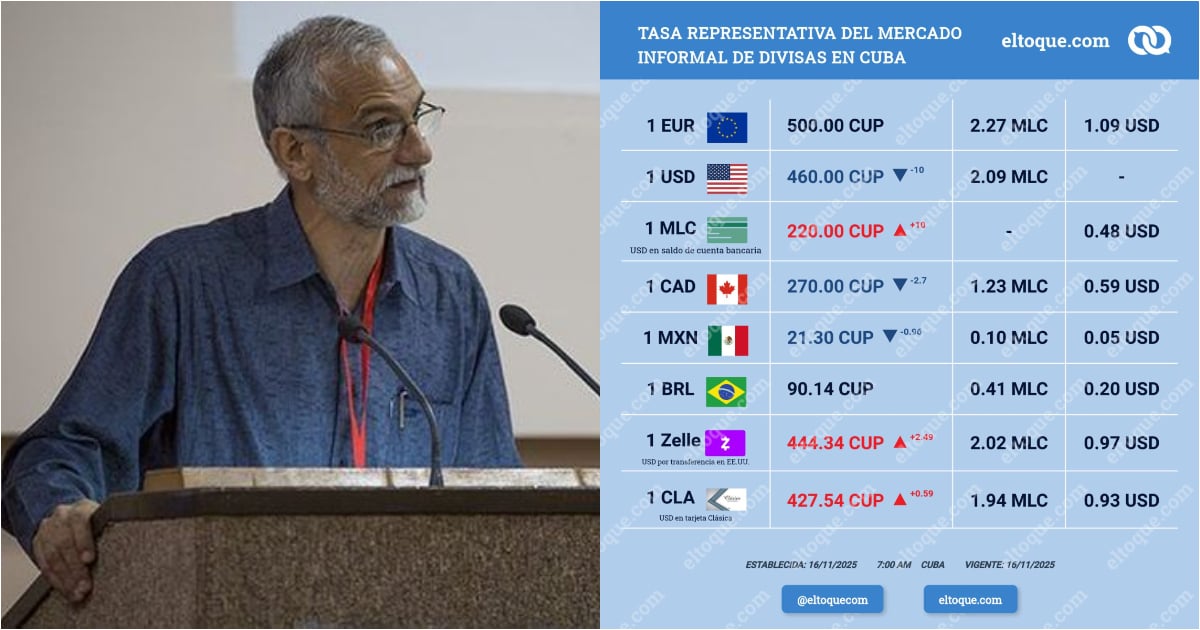
On Sunday, official Cuban journalist Ariel Terrero criticized the uncritical acceptance of the Cuban government's narrative that blames El Toque for influencing and distorting the Cuban currency market, describing it as "grotesque and devoid of any economic foundation."
In an extensive analysis posted on his Facebook profile, Terrero argued that manipulating currency markets in any country requires costly interventions by powerful economic entities—such as a central bank or a global financial conglomerate—to cause reactions in exchange rates, reactions that are often short-lived.
He suggested that if the capabilities attributed to El Toque were credible, Hungarian-American businessman and investor George Soros would envy José Jasán Nieves, the founder and director of the digital outlet.
As the dean of the Faculty of Communication at the University of Havana, Terrero described El Toque’s financial observatory as a "too small" team lacking the technical validation needed to assess a fragmented and opaque market like Cuba's.
The Informal Market Reference
While acknowledging that the Informal Market Representative Rate (TRMI) has become a reference in the absence of similar data, he noted, "A simple tour and dialogue with internal markets reveal daily differences between what El Toque states and the rates sellers apply when making currency conversions with their consumers."
The former vice president of the Union of Cuban Journalists criticized the outlet for allegedly receiving U.S. funding and collaborating with the U.S. Embassy in Havana on various civil society programs.
Nevertheless, he admitted that blaming El Toque for movements in the informal rate lacks economic logic: influencing exchange prices requires players with real financial power, not an outlet aggregating social media data.
Government’s Role in Economic Downfall
Terrero also pointed out that the Central Bank of Cuba (BCC) created an informational void that El Toque capitalized on, highlighting the government's failure to establish a flexible and transparent currency market after years of unmet promises.
"Authorities have clung to official rates that diverge from the real market—misleadingly called informal. The promise of creating a 'functional and transparent' currency market, reiterated by the BCC, has been on the table for over three years. We continue to wait," he argued.
Public Commentary and Expert Opinions
In the comments section, a stark contrast to the official narrative emerged. Economists and specialists directly pointed to internal causes of the phenomenon.
Economist Ileana Díaz Fernández highlighted that the current situation results from an informational void created by the state itself, which other actors merely filled.
Colleague Oscar Fernández was more explicit: someone in the government has been blocking attempts to formalize the currency market for at least three years, and regardless of current actions, "the damage is irreversible."
Historian Félix Julio Alfonso debunked another pillar of the official story, stating that the rate published by El Toque is not responsible for Cuba’s severe economic issues, starting with the inadequate salary system and ending with the dollarization of consumption, which is an affront to those without access to foreign currency.
Economist Hiram Marquetti added technical details, noting that the architects of the "Tarea Ordenamiento" failed to preserve the currency market, leading to the weakening of CADECA (Currency Exchange Houses). Despite new economic complexities, the 1-to-24 exchange rate was maintained, causing significant harm to businesses engaged in foreign trade.
Citizens were even more forthright. One remarked, "Talking nonsense is free, and in that, the Cuban government has no rival." Another bluntly summarized: blaming an external enemy is a classic maneuver of a government avoiding self-reflection.
Amid the turmoil, a comment injected a dose of uncomfortable realism that Terrero did not mention: the current polycrisis—economic, social, and political—only worsens when the government insists on finding external scapegoats and "refuses to acknowledge its responsibility in creating the current disastrous conditions."
El Toque’s Response to Government Accusations
Nieves rejected the regime's recent escalation of harassment and reaffirmed his political commitment to democracy in Cuba.
The escalation began on October 29 when Foreign Minister Bruno Rodríguez spoke of "evidence" of alleged manipulation of the exchange rate.
Official spokesperson Humberto López accused the outlet of being part of a "comprehensive economic warfare program" and operating a "financial terrorism" scheme, even suggesting potential legal proceedings and listing the project among entities "linked to terrorism."
Additionally, Cuban leader Miguel Díaz-Canel targeted the press outlet, accusing it of receiving external funding to devalue the Cuban currency and being part of a supposed "economic war" against the country.
The Central Bank of Cuba (BCC) also endorsed these claims in a statement questioning the legitimacy of the Informal Market Representative Rate (TRMi).
These government accusations contrast with the absence of a functional currency market, a gap forcing both citizens and businesses to rely on the informal market's reference value.
Understanding Cuba's Currency Market Issues
What did Ariel Terrero criticize about the Cuban government's narrative?
Ariel Terrero criticized the Cuban government's narrative for blaming El Toque for influencing the currency market, calling it "grotesque and devoid of any economic foundation."
How did the public and experts react to the government's stance on El Toque?
Public and expert reactions highlighted internal causes for Cuba's economic issues, criticized the government for its role in creating an informational void, and dismissed the blame on El Toque as unfounded.
What impact has the absence of a functional currency market had in Cuba?
The absence of a functional currency market has forced citizens and businesses to rely on the informal market's reference value, leading to economic instability and exacerbating the country's economic challenges.