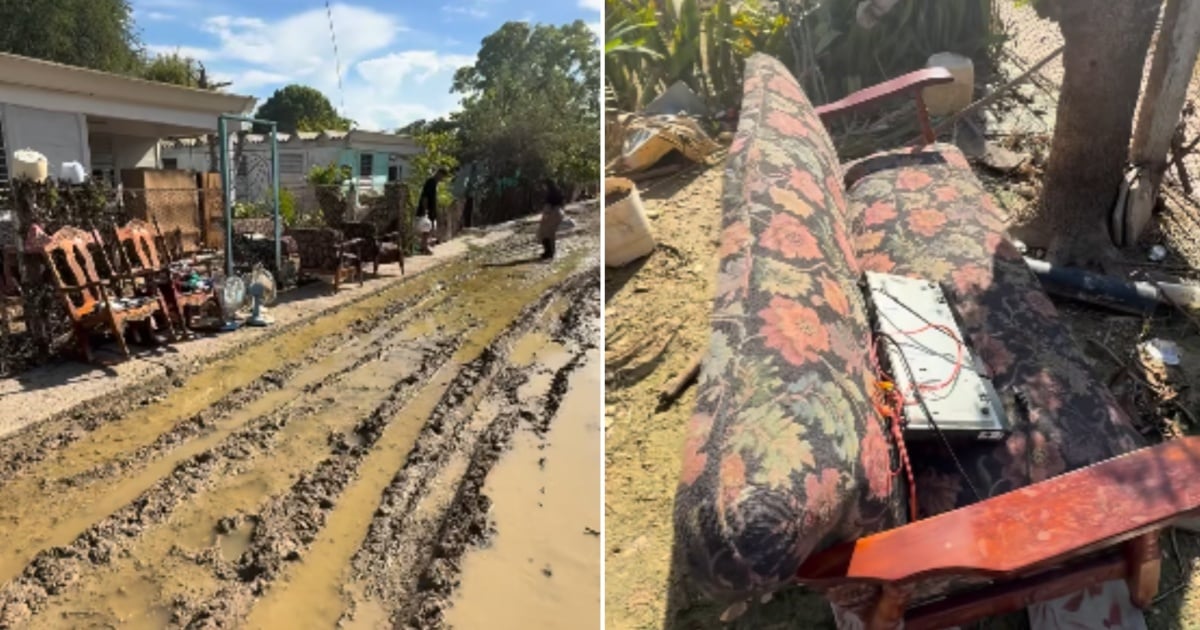
Rural families in Holguín find themselves living amidst mud and open skies following recent floods caused by heavy rainfall, a situation compounded by the devastation left by Hurricane Melissa, from which recovery had barely begun.
A report by La Familia Cubana channel reveals the dire conditions in Holguín communities like Yaguabo and Mayarí. Homes in these areas exhibit eroded floors, ruined mattresses, walls torn down by the river, and elderly residents struggling to move with canes across floors that no longer offer safety.
In one home, an elderly woman is seen moving with great difficulty, supported by a cane. Her relatives recount how she fell into a hole that had been gouged into the floor by rushing water that lifted the ground itself.
“I thought the floor was even, and then suddenly I was gone,” the woman explains, as visitors point to the spot where she fell. The hole was "patched" as best as possible with dirt and sheets of zinc, yet it remains a hazardous area, especially at night when darkness hides the sharp metal edges.
The homeowner shares that a mother and daughter used to reside there, each with their own bed. Today, only a soggy, misshapen mattress remains, partially salvaged from the water. “The river completely destroyed the other mattress, leaving it unusable. Now it's just me and her on this one,” she says, pointing to the spot where the other bed once stood.
To sit, they've had to cover the springs with boards and fabric in a feeble attempt to reclaim some semblance of comfort on the still-damp furniture.
The walls were swept away by the flood. “This used to be enclosed... the river, when it rose, with no other outlet, surged back and created this hole,” the woman explains, pointing to where the water had forcefully entered.
La Familia Cubana describes the home as "severely damaged," virtually perched on the river's edge. Nearby, others share stories of tree branches falling on people, fortunately causing only minor injuries, yet highlighting the vulnerability of those who have lost nearly everything.
Amidst the mud, donations of food and basic goods offer temporary relief, though there's a pervasive sense of uncertainty with each new downpour.
Images and accounts from Mayarí are part of a broader scene of intense rains and river overflows in eastern Cuba. In Holguín, recent rainfall measured 109 mm, leading to floods and prompting efforts to protect water supply systems from further damage, according to local official reports.
More than 11,000 customers in Sagua de Tánamo continue to receive services, while reservoirs, reportedly in good technical condition, are under surveillance.
In eastern Holguín, evacuations persist due to rising rivers in Sagua de Tánamo and Moa, affecting areas such as the Pedro Soto Alba (Ecrin) neighborhood.
Last Wednesday's heavy rains had already caused the Sagua and Cabañas rivers to overflow, necessitating the urgent evacuation of hundreds of families in the municipalities of Sagua de Tánamo and Moa, among the hardest hit by Hurricane Melissa.
While official reports mention controlled reservoirs, monitoring, and evacuation operations, footage from aid workers shows families like those in Mayarí still sleeping on damp mattresses, navigating shattered floors, and living with the river mere meters from their doorsteps—literally in the mud and under the stars, with the constant fear that another surge could take the little they managed to salvage.
Impact of Flooding in Holguín
What caused the current flooding situation in Holguín?
The flooding in Holguín is primarily due to intense rainfall, which compounded the damage from the previous impact of Hurricane Melissa. The heavy rains resulted in river overflows and widespread flooding in rural areas.
How are residents coping with the aftermath of the floods?
Residents are struggling with damaged infrastructure, including eroded floors and destroyed personal belongings. Temporary relief comes from donations of food and basic supplies, but the uncertainty of future rains looms large.
What measures are being taken to assist affected families?
Evacuations are ongoing, and efforts are being made to monitor water reservoirs and protect technical systems to prevent further damage. Aid workers are providing essential supplies to those in the hardest-hit areas.