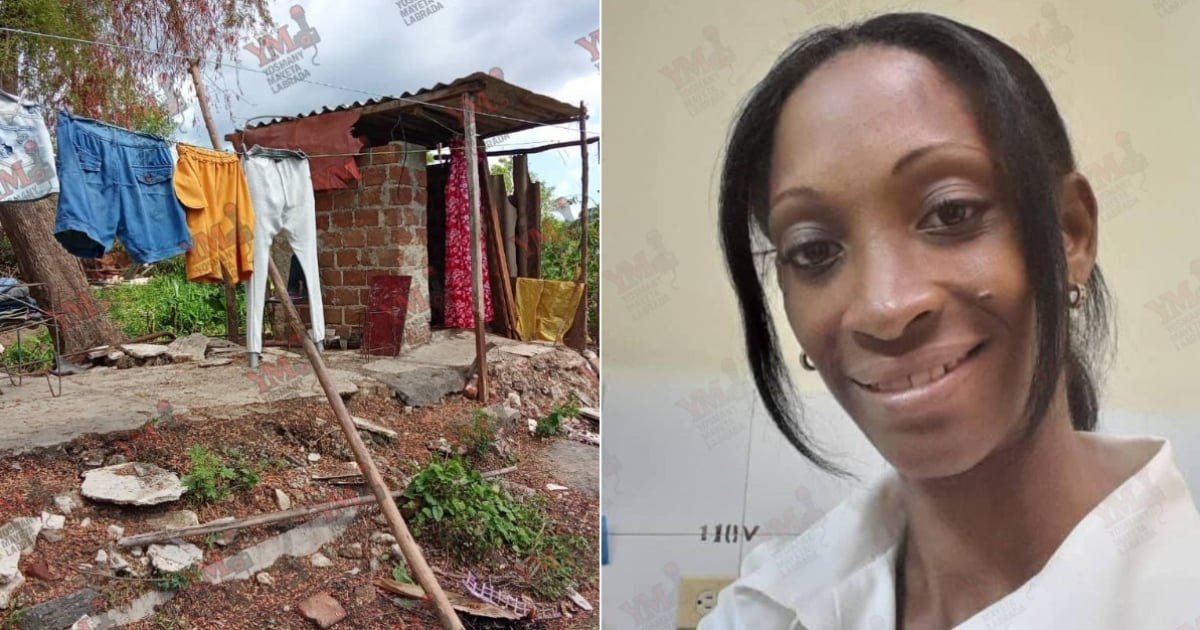
In a stark contrast, trucks loaded with donations come and go under strict supervision at "Los Chinos" port in Santiago de Cuba, while just a short distance away, a family devastated by Hurricane Melissa remains without aid.
This is the reality for Lizandra Estrada Mustelier, a nurse at the Frank País García Polyclinic. As a mother of two and caregiver for her sick mother, she has become a symbol of the neglect faced by many families in the province following the cyclone.
Her situation came to light when independent journalist Yosmany Mayeta Labrada shared her story on Facebook. At 33, Lizandra lost almost everything when the river near Mar Verde Road at kilometer 1 overflowed violently. The floodwaters invaded her home, destroying her belongings, and a mango tree later toppled onto what little was left standing.
Living in these conditions are her children, aged 8 and 11, her 67-year-old mother who is retired due to illness, and Lizandra herself, surrounded by damaged walls and muddy floors in a house that no longer feels like home.
Throughout her neighborhood, the scene is similarly bleak: total collapses of five homes, mothers left to fend for themselves, and elderly residents who have lost everything. Yet, what is most infuriating is the official silence.
The Absence of Government Support
No local delegate has shown up, no Party or Government representative has visited, electricity has not been restored, and no state assistance has arrived. Meanwhile, trucks continue to deliver donations to the nearby port.
Despite passing by these affected families, the aid-laden trucks do not stop. Officials with credentials strictly control who accesses these humanitarian supplies, ignoring those waiting on the sidelines, desperate for aid.
When Lizandra sought understanding from her workplace, the only offer she received was an unpaid leave of absence—a humiliating response for a woman dedicated to saving others, now feeling invisible in her own misfortune.
Community Resilience in the Face of Disaster
Images shared by cautious neighbors reveal a scenario the state refuses to acknowledge: destruction, hardship, and families left entirely unsupported. True solidarity has emerged from Lizandra's colleagues and neighbors, who organized to provide food, support, and basic supplies. No government authority has stepped up to their responsibilities.
Lizandra's story is not an isolated incident. In Santiago de Cuba, 75-year-old Ulises Castro Reyes from the marginalized El Resplandor neighborhood lost his home for the second time to a hurricane. After Hurricane Sandy in 2012, Melissa once again left him with only makeshift shelter.
His family, echoing a common sentiment, insists that aid distribution follows political convenience or media visibility, leaving entire communities overlooked. They question how aid can reach those truly in need when local committees are dysfunctional, inspectors are corrupt, and donations frequently get diverted.
The People's Solidarity
Meanwhile, in Songo, a pregnant woman with three young children endures extreme conditions—a dirt floor turned to mud, children without dry mattresses, no official assistance, and a local delegate who simply advised airing out the mattress in the sun.
Despite Prime Minister Manuel Marrero Cruz's assurances that "no one will be left unassisted," the documented reality is a province mired in neglect. Over 95,000 homes have sustained damage, less than half have had their electricity restored, and thousands of families are unable to recover in a country where wages are insufficient for basic needs.
While institutions fail, independent support networks are flourishing. For example, Cáritas Santiago de Cuba activated its parish structure immediately, distributing over 4,400 food rations, detergent, and soap to those affected. Volunteers, like jeweler Mijaíl García, traveled hundreds of miles to deliver essentials to families in Guamá who lost everything.
It is these acts of kindness that sustain shattered communities, not government promises. It is ordinary citizens who traverse muddy paths, erect makeshift walls, feed strangers, and stand alongside those who have lost it all.
Each hurricane exposes a deep-seated poverty not caused by the climate, but by decades of deterioration and neglect. Cuban families face these meteorological challenges without savings, resources for rebuilding, or accessible materials, relying solely on the help of fellow citizens—not on a state that appears only for the cameras.
The plight of nurse Lizandra Estrada Mustelier encapsulates the experiences of countless families: homes in ruins, children at risk, vulnerable elders, and a nation where solidarity stems from the people, while institutional aid remains inactive, even as it passes just a few meters away.
Understanding the Crisis in Santiago de Cuba
What is the current situation for affected families in Santiago de Cuba?
Many families in Santiago de Cuba are living in devastated conditions following Hurricane Melissa, with no state aid reaching them despite the presence of donations in nearby ports.
How are independent support networks assisting those in need?
Independent support networks, such as Cáritas Santiago de Cuba, have activated parish structures to distribute essential supplies, while volunteers provide additional support, traveling to deliver necessities to affected areas.
What challenges do Cuban families face after hurricanes?
Cuban families often confront hurricanes without savings or resources for rebuilding, relying on the support of fellow citizens rather than government assistance, which is frequently absent or insufficient.