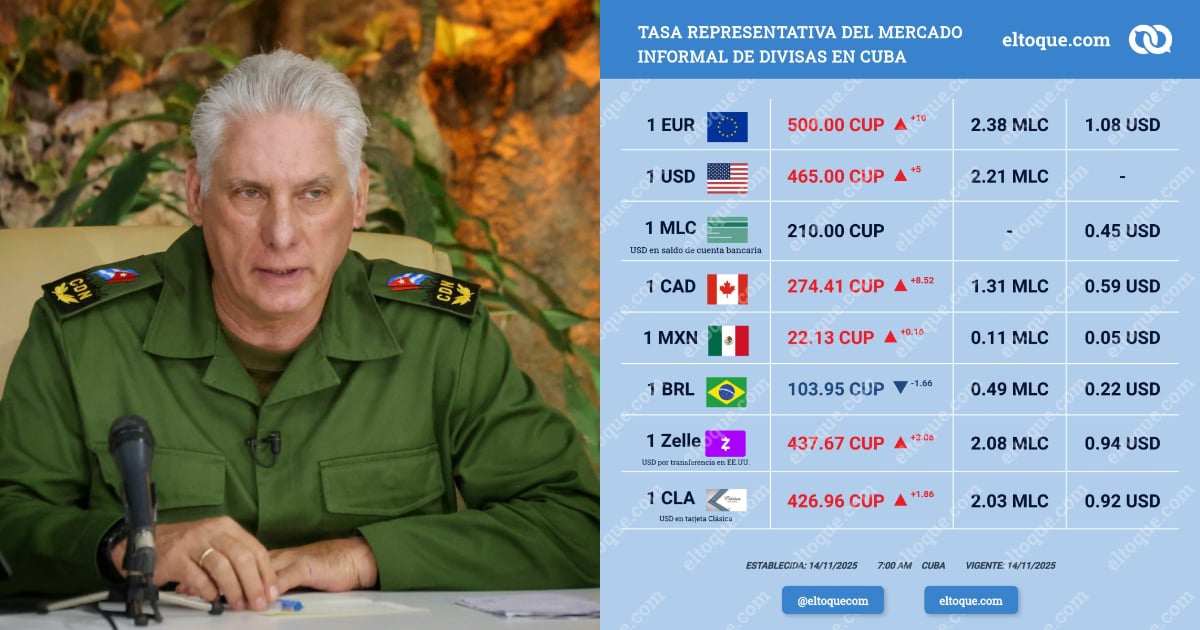
President Miguel Díaz-Canel aligned himself on Friday with the state-led campaign targeting the independent media outlet El Toque, accusing it of being externally funded to undermine the Cuban currency as part of an alleged "economic war" against the nation.
In a statement on his X account, Díaz-Canel claimed, "The economic war on Cuba is designed to severely reduce the income of the Cuban people."
The president accused El Toque of being a part of this strategy through "proven financing" aimed at deepening the devaluation of the currency.
These remarks from the First Secretary of the Communist Party of Cuba add to an official offensive that, over the past two weeks, has placed the outlet at the center of accusations of "speculative manipulation."
Also on Friday, the Central Bank of Cuba (BCC) supported these allegations in a statement questioning the legitimacy of the Informal Market Representative Rate (TRMi).
The BCC described the exchange rate reference published by El Toque as a "distorted signal" affecting prices, expectations, and decisions of the public.
Moreover, the bank claimed it is working on establishing an "orderly and transparent" official foreign exchange market, though it provided no specific dates or details.
The escalation began on October 29, when Foreign Minister Bruno Rodríguez mentioned "evidence" of alleged manipulation of the exchange rate.
Subsequently, official spokesperson Humberto López accused El Toque of being part of a "comprehensive economic warfare program" and operating a "financial terrorism" scheme, hinting at potential legal proceedings and the possibility of listing the project among entities "linked to terrorism."
The government’s accusations and its spokespersons sharply contrast with the absence of a functional currency exchange market, a gap that has forced both citizens and businesses to rely on the informal market's reference value.
In response, the official discourse seeks to portray the information published by El Toque as the root of the currency crisis, rather than a result of the lack of credible economic policies and unsuccessful strategies.
Activist Amelia Calzadilla argued on Friday that El Toque merely reports the daily activity of Cuba's informal currency market and that the dollar's rise is not due to any imposed algorithm, but rather to government decisions, such as selling food, essential goods, and appliances in foreign currency stores while people earn wages and pensions in a severely devalued Cuban peso.
FAQs on Cuba's Economic Crisis and El Toque
Why is El Toque accused of economic sabotage?
El Toque is accused of being funded externally to manipulate the Cuban currency, contributing to an alleged economic war against Cuba by reporting on the informal market rates.
What is the Informal Market Representative Rate (TRMi)?
The TRMi is an exchange rate reference used by El Toque to report on Cuba's informal currency market, which the Central Bank of Cuba claims is a "distorted signal" affecting the economy.
How does the government view El Toque's reporting?
The government views El Toque's reporting as part of a strategy to undermine the Cuban economy, accusing it of speculative manipulation and financial terrorism.