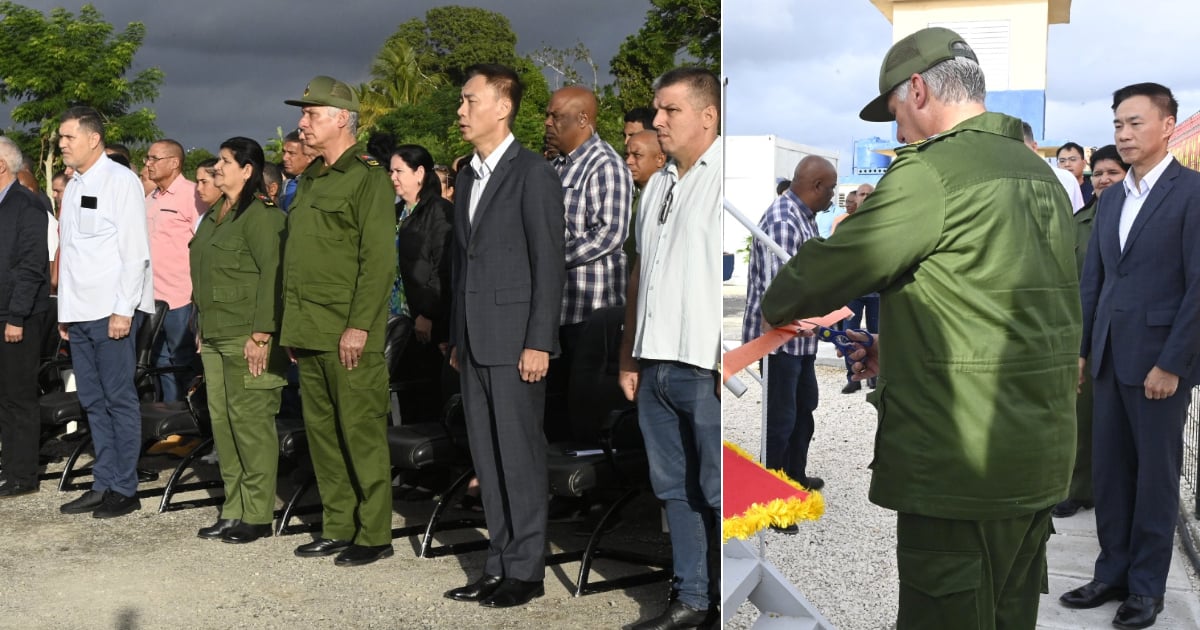
The recent unveiling of the "Mártires de Barbados II" solar park in Artemisa, led by Miguel Díaz-Canel, has stirred a wave of critical and sarcastic comments among Cubans on social media. Many expressed their dissatisfaction with the persistent power outages and the lack of tangible improvements in the electrical grid.
This solar facility, boasting a capacity of 5 megawatts (MW), is part of a donation from the Chinese government, which includes seven similar projects in its initial phase, totaling 120 MW. During the ceremony, Díaz-Canel expressed gratitude to "the sister nation for its unwavering support, especially during challenging times," while official outlets like Cubadebate and the Unión Eléctrica (UNE) hailed it as a step towards energy independence.
Nevertheless, skepticism and humor dominated the online discourse. One user remarked, "Every time they announce a new solar park, the blackouts increase," while another jested, "5 MW is the average consumption of Canel’s house." Comments also included quips like "they’ll need sunlight 24/7" or "that’s enough for the party, the government, and a few small companies as long as there's sun."
Critics highlighted the disparity between official propaganda and daily life. In the words of one user, "There's a blackout in the same municipality as the park due to a deficit," and another succinctly described it as "A political act for 5 MW."
The criticisms extended to the perceived reliance on external aid. "They live on donations and handouts," one person wrote, while another added, "Cuba isn't alone... there's always a country willing to lend a hand, knowing Cuba can't pay it back in 20 years." Another user harshly stated, "Cuba's problem isn't energy; it's the mafiosos in power."
Messages also echoed the frustration over the lack of real solutions: "Look, we’ve been without power for 17 hours here in the same province," read one comment; another noted, "Every time they build one, the blackout lasts longer," and yet another called the event "shameful, we are nothing now, not even next to Haiti."
While some supportive messages appeared—such as "Keep going, my president, always making a revolution," "Cuba isn't alone, many countries extend their good hands to a sincere friend," or "Thanks to China for its help and solidarity with our people"—the overall sentiment was one of skepticism and mistrust.
According to the Unión Eléctrica, the seven connected solar parks will contribute 35 MW in this first phase, with a second phase adding another 85 MW. Chinese ambassador Hua Xin claimed the project would save approximately 18,000 tons of fuel annually. However, these announcements come amid widespread blackouts and a generation shortfall exceeding 1,500 MW daily, leaving much of the country in constant darkness.
The prevailing mood among users was captured in a comment that summed up the general tone: "They talk about light, but we're still in the dark. No power, no water, and yet they celebrate donations as if that's progress."
Cuban Energy Crisis and Solar Park Development
What is the significance of the Mártires de Barbados II solar park in Cuba?
The Mártires de Barbados II solar park is part of a Chinese-sponsored initiative contributing to Cuba’s renewable energy capacity. However, its introduction has been met with skepticism due to ongoing electricity shortages.
How have Cubans reacted to the new solar park in Artemisa?
Many Cubans have expressed critical and sarcastic views, citing continued power outages and questioning the effectiveness of the government’s energy initiatives.
What are the expected benefits of the solar parks funded by China in Cuba?
The solar parks are expected to collectively provide 120 MW of power, potentially saving 18,000 tons of fuel annually, according to Chinese officials. However, doubts persist due to Cuba's current energy deficits.