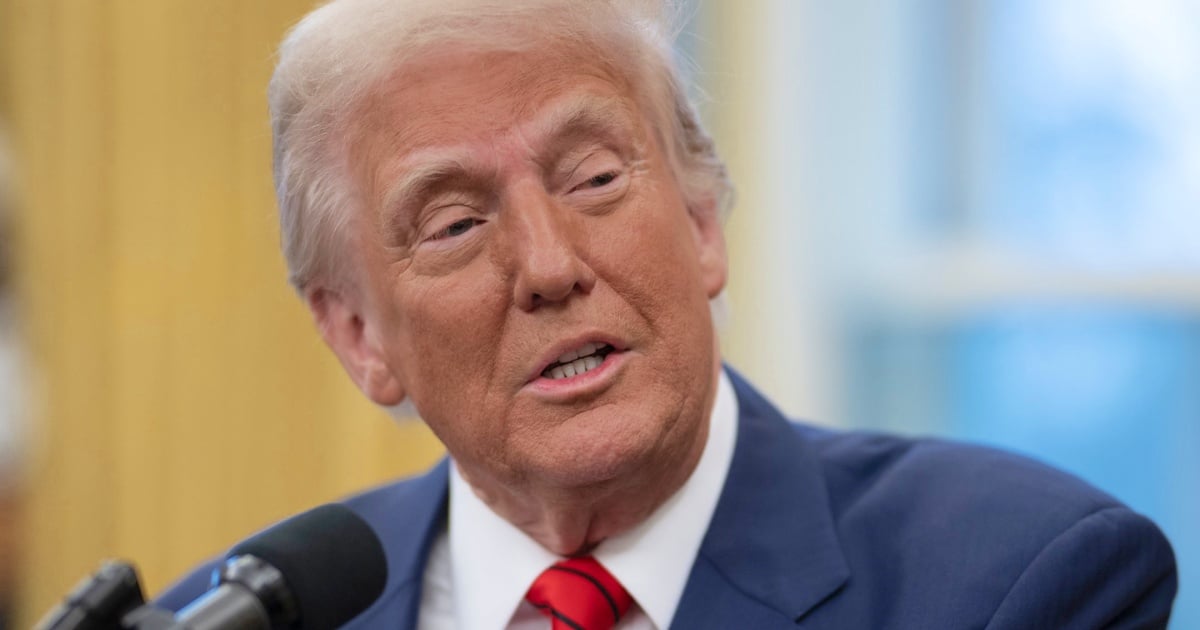
Over the weekend, senior members of the Trump administration tempered expectations set by the president himself, who had pledged a $2,000 "dividend" funded by tariff revenues.
Key government secretaries and advisors under Donald Trump took to the airwaves on Sunday to clarify the president's statements. He had announced via his platform, Truth Social, a series of measures including direct payments to citizens and a healthcare system overhaul based on individual transfers.
The most eye-catching of his promises was a $2,000 check per person, allegedly financed through his tariff policy revenues.
Reality Check on the $2,000 Tariff Dividends
While the president claimed these funds could help reduce the national debt and improve access to private health insurance, his officials quickly downplayed the announcements.
"We don't have a formal proposal," Treasury Secretary Scott Bessent clarified during an interview with ABC News. "We're not presenting it to the Senate right now, no."
National Economic Council Director Kevin Hassett echoed this sentiment, describing the president's announcements as an exploration of ideas amid a legislative stalemate caused by the prolonged partial government shutdown.
"The president floated this idea yesterday. I don't think it's been widely debated in the Senate yet. It's the weekend," he commented on CBS News' Face the Nation.
Digital Decrees and Healthcare Reform
Trump's proposals were shared on Truth Social over the weekend, coinciding with the 41st day of the partial government shutdown.
In an initial message, the president suggested eliminating subsidies to private insurers under the Affordable Care Act (Obamacare), proposing instead to redirect those funds directly to citizens for them to choose their own insurance.
"I recommend to Republican senators that the hundreds of billions of dollars currently going to profitable insurance companies to salvage the failing care provided by Obamacare be sent directly to the people so they can buy much better health insurance," he wrote.
The following day, he stressed that Republicans should deposit that money into health savings accounts, which allow for tax-free medical expense savings.
Another message promised economic dividends from his tariff policy: "We are collecting trillions of dollars and will soon start paying down our MASSIVE $37 trillion DEBT. […] A dividend of at least $2,000 per person (excluding high-income individuals!) will be paid to everyone."
Focus on Reopening the Government
Although Trump promoted these ideas as urgent proposals, his economic spokespersons emphasized that nothing could be seriously discussed until the government reopened.
"The president is posting about it, but again, we have to reopen the government first. We're not negotiating with Democrats until they reopen the government. It's very simple," Bessent stressed.
Both Bessent and Hassett avoided confirming any legislative drafts or formal proposals to materialize the president's promises, interpreting them instead as part of a strategy to force an agreement in the Senate. "He's looking for ideas and trying to help the Senate reach a deal to reopen the government," Hassett explained.
Funding Sources and Political Strategy
Regarding the feasibility of a "tariff dividend," Bessent was cautious. He admitted he had not yet discussed this particular proposal with the president and suggested it could take other forms, such as tax deductions, exemptions, or reforms.
He mentioned, for instance, the potential elimination of taxes on tips, overtime, Social Security contributions, or auto loans, all supposedly funded by tariff revenues.
The concept of checks funded by trade revenues isn't new. In July, Republican Senator Josh Hawley introduced a bill proposing $600 checks to every citizen using funds from tariff revenues. However, that initiative has yet to be voted on in the Senate and hasn't garnered majority support.
Political Crisis and Electoral Warning
Trump's publications and subsequent clarifications by his officials came as Congress remained deadlocked due to the partial government shutdown, prompting legislators to session over the weekend.
Though a preliminary agreement was reached Sunday night to end the shutdown, the stalemate had already begun to take a political toll. An NBC News poll showed voters blaming Republicans more than Democrats for the situation.
This was compounded by the previous Tuesday's elections, where Democrats achieved significant victories in key states like New Jersey and Virginia. Exit polls showed high disapproval of Trump's management, particularly on economic issues.
Since then, the president has insisted that the American economy is strong and has defended his trade policy as a success. "Those who oppose tariffs are fools!" he wrote on Sunday on Truth Social.
"We are now the richest and most respected country in the world, with nearly zero inflation and record stock market prices," he added.
The Gap Between Promises and Plans
The events of this weekend reflect a pattern characterizing Trump's presidency: large-scale promises made via social media without clear institutional backing.
While the president continues to use his platform to set the political pace, his own government's officials seem more focused on managing expectations than designing mechanisms to fulfill them.
In a scenario of growing electoral pressure and the looming threat of another round of primaries, the announcements of direct checks and tariff dividends may be more a part of a political mobilization strategy than a legislative roadmap.
For now, the promise of the $2,000 "tariff check" seems more like a headline than a policy in the making. The gap between presidential messages and cabinet action confirms that in times of crisis, not every post translates into a plan.
Understanding Trump's Tariff Check Proposal
What was the proposed $2,000 tariff check?
The proposed $2,000 tariff check was a promise by President Trump to provide direct payments to citizens, funded by revenues from his tariff policy. However, this proposal was not formalized and faced skepticism from his administration.
How did Trump officials respond to the tariff check announcement?
Trump officials, including Treasury Secretary Scott Bessent and National Economic Council Director Kevin Hassett, clarified that there was no formal proposal for the $2,000 tariff check and emphasized that reopening the government was the priority.
What was the political context surrounding the tariff check proposal?
The proposal came during a prolonged partial government shutdown, which had significant political implications. Republicans were largely blamed for the shutdown, and Democrats gained victories in key state elections, adding pressure on the Trump administration.
Is there historical precedence for using tariff revenues for direct payments?
Yes, there have been previous proposals to use tariff revenues for direct payments. For example, Senator Josh Hawley introduced a bill for $600 checks funded by tariffs, but it hasn't progressed in the Senate.