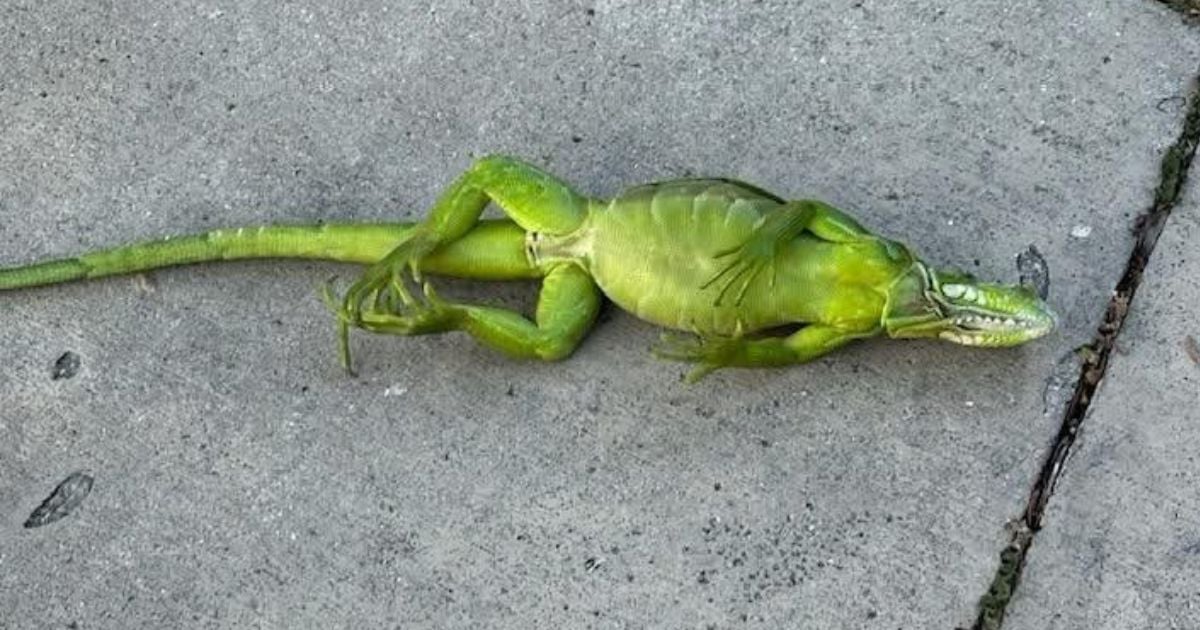
The recent chill sweeping through South Florida, with temperatures plunging to around 38 degrees Fahrenheit (about 3 degrees Celsius), has led to numerous iguanas falling from trees as they become immobilized by the cold. This phenomenon is a recurring event during particularly harsh winters in the state.
According to meteorologist Matt Devitt, a large iguana fell from a tree in Port Charlotte, just north of Fort Myers, as the temperature dropped to approximately 3 degrees Celsius. "It's not dead, just stunned by the cold," he clarified in a Facebook post on Tuesday.
Residents across Florida have shared images of this unusual occurrence. On the social platform X, user @Vic1972 humorously remarked that while other states face snow alerts, Florida issues warnings for iguanas dropping from trees.
Another user, @LauraJ, posted a photo of a motionless reptile lying on the pavement, captioning it: "Just another chilly morning in Florida."
The National Weather Service in the United States issued a warning on Monday about a cold wave impacting two-thirds of the country, with Florida experiencing record-low temperatures. Freeze warnings were announced in several counties, cautioning that the temperature drop could render iguanas immobile.
This situation arises due to a polar air mass moving south from northern regions, causing temperatures to plummet between 21 and 30 degrees Fahrenheit. In Florida, Brevard, Lake, Orange, Volusia, Levy, and Hernando counties are under a cold air advisory, and historic low temperatures are being recorded in Orlando, Lakeland, and Brooksville, nearing the coldest readings since 1894.
As reported by EFE, the South Florida Wildlands Association reminded that when temperatures approach 40 degrees Fahrenheit, cold-blooded iguanas from Central and South America lose mobility and fall from trees or rooftops, though they remain alive.
The MyRadar Weather service also released an "iguana falling" alert for early Tuesday morning in central and southern Florida, warning that these creatures might stay immobile for several hours before regaining movement.
Weather.com explained that this phenomenon occurs when temperatures fall below 50 degrees Fahrenheit, slowing the iguanas' metabolism and preventing them from clinging to branches. Once the weather warms up, they regain mobility and return to their natural habitats.
Experts advise against touching or trying to assist the iguanas, as they might react abruptly and potentially cause injuries once they warm up.
Temperatures are anticipated to rise mid-week, allowing iguanas to return to the trees and for South Florida to regain its usual climate.
Although this event is always a spectacle, it is not unprecedented. In 2021, the Miami Weather Service (NWS) also reported iguanas falling in Florida due to a similar temperature drop.
Understanding Iguanas and Cold Weather Phenomena
Why do iguanas fall from trees during cold weather?
Iguanas are cold-blooded reptiles, and when temperatures drop significantly, their metabolism slows down, causing them to lose grip and fall from trees as they become immobile.
Are iguanas harmed by falling from trees?
While the fall might seem dangerous, iguanas are generally not harmed. They are simply stunned by the cold and remain alive, regaining mobility once temperatures rise.
What should you do if you see a fallen iguana?
It is best to leave fallen iguanas alone, as they may react unpredictably when they warm up. They will usually recover and return to their habitat on their own.