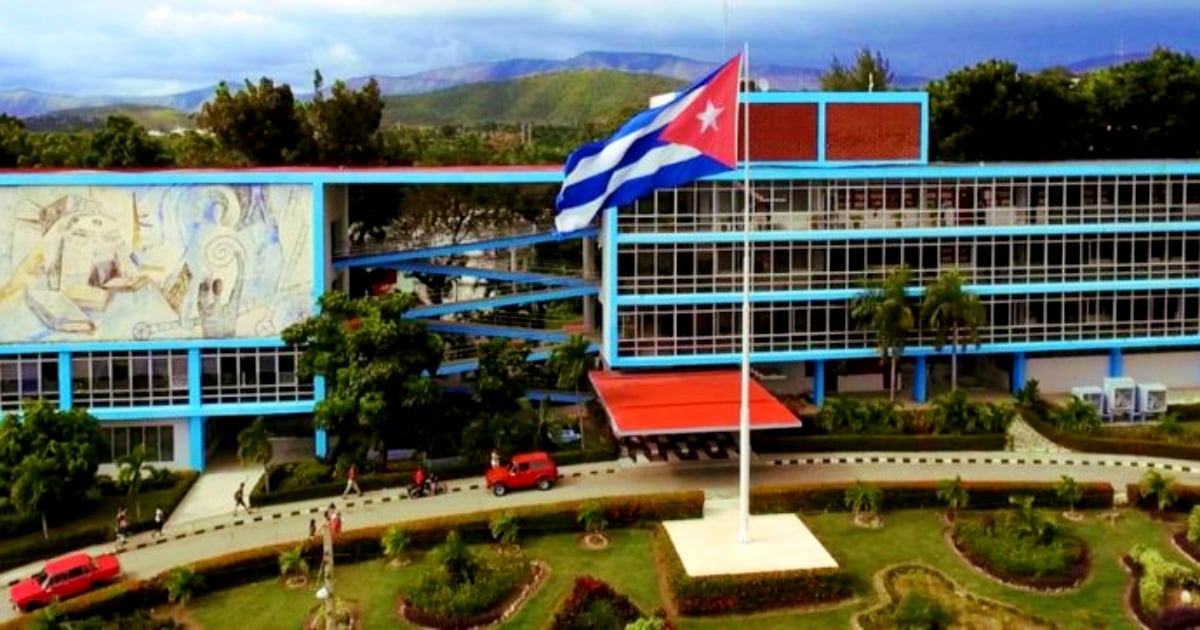
The University of Oriente (UO), one of Cuba's most esteemed academic institutions, is currently experiencing a period of sorrow and confusion.
Since October 1, at least eight deaths among faculty, students, and staff associated with the university have been reported, as highlighted on social media by activist Yamilka Lafita Cancio (also known as Lara Crofs).
"Families are shattered, and people online are asking: what caused these deaths? Neither the university nor the Ministry of Higher Education is providing answers. All they say is 'rest in peace,'" Lafita expressed, deeply disturbed by what she described as an "unusual chain of deaths."
Obituaries released by the institution itself confirm the deaths of Raudel de Armas Louis (Biology Department professor), Beatriz Carmenaty Corona (Sociocultural Management student), Luis Enrique Vicet Castellanos (Mechanical Engineering student), Pedro Antonio Rodríguez Fernández (Agronomy professor), Elio Hermis Castellanos Caballero and Santiago Parra Boffil (retired professors), Mario Trenard, and Lara Saint Félix, a young Education Sciences professor.
Sweeping Silence and Digital Censorship
The university community in Santiago de Cuba is in shock as no official explanation has been provided regarding the causes of these deaths. Students and faculty members have reported that the university has been deleting comments calling for transparency about the fatalities. Official responses are limited to condolences, with no medical or epidemiological details shared.
"Is it mere coincidence, or the secrecy that state institutions are known for?" questioned Lafita, pointing out the Cuban authorities' tendency to handle public health issues, particularly those involving epidemic outbreaks or mass deaths, with secrecy.
Crisis-Driven University Struggles
The lack of official information has fueled concerns and rumors about a potential link between the deaths and the broader national epidemiological crisis, marked by the spread of dengue, chikungunya, and Oropouche virus, affecting several eastern provinces.
The University of Oriente, with a history spanning over 75 years and an estimated enrollment of 11,000 students, has been at the center of troubling news in recent months. Since August, various official and community reports have highlighted the spread of arboviral diseases in Santiago de Cuba, worsened by a lack of fumigation, garbage accumulation, and medication shortages.
Local medical sources, speaking anonymously, have acknowledged that hospitals in Santiago de Cuba are overwhelmed with patients and face bed and transportation shortages, delaying treatment for many.
Underreporting and Alarming Estimates
In October, the Ministry of Public Health (MINSAP) reported over 13,000 febrile cases in a single week but refrained from disclosing the number of deaths. Independent organizations claim that the actual number of cases is much higher, with Santiago de Cuba being one of the hardest-hit provinces.
In this context, the eight deaths at the UO in just 40 days appear to be part of a broader pattern of mortality linked to healthcare system deterioration and service collapse.
If the death rate observed at the University of Oriente—eight deaths among approximately 11,000 students—were extrapolated to Cuba's total population, the outcome would be alarming.
According to the National Office of Statistics and Information (ONEI), Cuba's population stands at 9.7 million, which would equate to over 7,000 deaths in just one month. However, demographer Juan Carlos Albizu-Campos estimates the actual Cuban population to be around 8 million due to mass emigration, translating to roughly 5,800 deaths in the same period.
Potentially Catastrophic Consequences
While this is a hypothetical estimate without statistical scientific basis, it reflects the potential magnitude of the health crisis if the situation at the University of Oriente were replicated nationwide. Experts warn that, if confirmed, this pattern "would be alarming even for a country at war or in a pandemic." However, the authorities' silence prevents understanding the real causes and hinders efforts to prevent further cases.
In a nation exhausted by health and demographic crises, where hospitals lack resources and dengue and other arboviral diseases spread unchecked, these projected figures reveal the human dimension of Cuba's structural decay.
Lack of Contingency Plans and Rising Anxiety
Activist Lara Crofs also raised concerns about whether universities and educational centers have prevention and contingency protocols to combat the spread of these diseases. "These are your children, your relatives, your friends... what measures are in place to protect them?" she asked in her post.
So far, the Ministry of Higher Education (MES) has issued no statement on the situation. Neither the provincial health department nor the university administration has provided details about the deaths or potential links to infectious diseases.
On social media, messages of mourning are interspersed with expressions of outrage. "How many more have to die for the truth to be told?" wrote one user on the University of Oriente's official page before her comment was removed.
Meanwhile, the death toll continues to rise, and institutional silence grows deafening. The university community, already grappling with scarcity, heat, and poor living conditions in dormitories and labs, now lives in fear and uncertainty.
The question on everyone's mind, both on and off the island, remains: What is happening at the University of Oriente?
Understanding the Crisis at the University of Oriente
What has caused the deaths at the University of Oriente?
The causes of the deaths remain unclear as neither the university nor the Ministry of Higher Education has provided any official explanation or details.
Is there a link between the deaths and the national epidemiological crisis?
There are concerns and rumors about a potential connection, but no official confirmation has been made regarding any link to the broader health crisis marked by diseases like dengue and chikungunya.
How has the community reacted to the situation at the University of Oriente?
The community at the University of Oriente is in shock and demanding transparency, with many expressing their grief and frustration on social media about the lack of information and accountability.