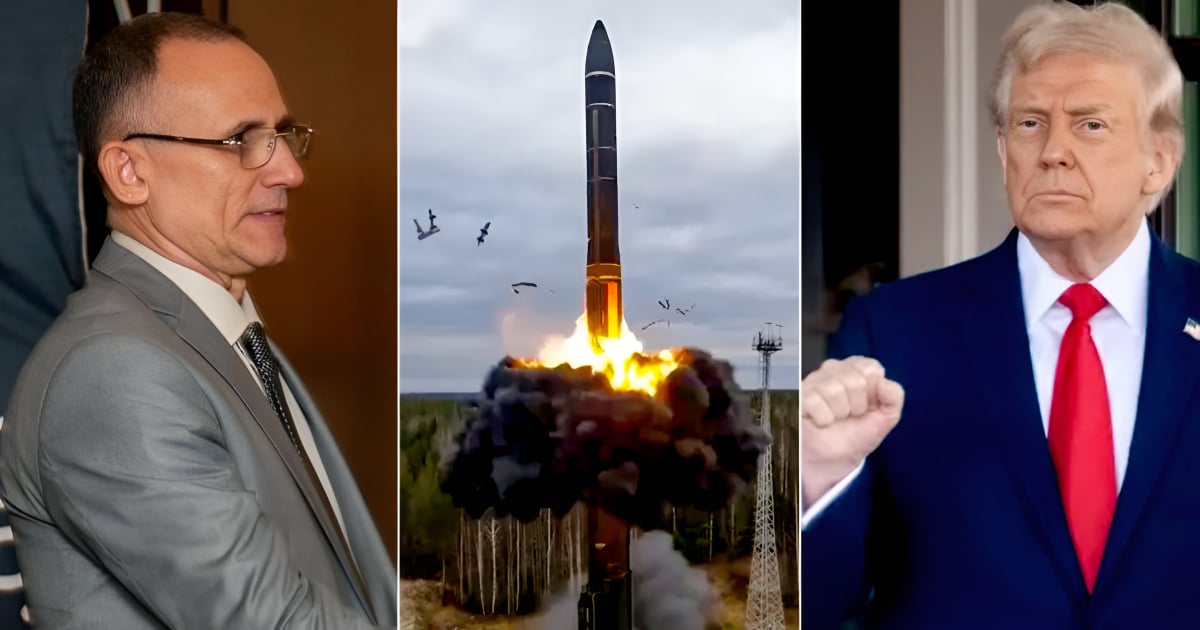
Cuban opposition leader José Daniel Ferrer has issued a stern warning to President Donald Trump following reports of Russia's latest military shipments to Venezuela.
"If the United States isn't vigilant, Russia could send nuclear warheads to Nicolás Maduro. Let's not forget the events of Cuba in 1962," Ferrer wrote on the social media platform X (formerly known as Twitter).
Ferrer drew parallels to history, noting that the failed Bay of Pigs invasion and the perceived weakness of John F. Kennedy allowed Fidel Castro to solidify his dictatorship, eventually leading to the installation of Soviet missiles on the island.
"Should Trump repeat this mistake, the security of the United States could be more at risk than ever before," warned Ferrer, who coordinates the Patriotic Union of Cuba (UNPACU). He emphasized that without a strong response, the regimes of Venezuela, Cuba, and Nicaragua could become "massive Russian, Chinese, and Iranian aircraft carriers, perpetually threatening North America."
Russia Strengthens Venezuelan Arsenal
Ferrer’s remarks coincide with the Kremlin's announcement of deploying Pantsir F-1 and Buk-M2E air defense systems to Caracas, in addition to the 5,000 Igla-S portable missiles already stationed there.
Russian officials are not ruling out the future delivery of Oreshnik hypersonic ballistic missiles and Kalibr cruise missiles, which Moscow is currently using in Ukraine.
"We maintain constant communication with our Venezuelan friends," stated Dmitri Peskov, spokesperson for the Russian presidency, referencing "contractual obligations" stemming from the strategic agreement signed between Putin and Maduro last May, which includes military collaboration.
Meanwhile, two U.S. B-52 bombers conducted deterrent maneuvers near Venezuelan airspace this week, and the USS Gerald Ford carrier continues its deployment towards the Caribbean, where over 10,000 U.S. troops are already operating.
Uncertainty in Washington and Caribbean Tensions
As tensions rise, there is internal debate within the Trump administration regarding the advisability of military action against Venezuela.
According to leaks in the American press, the President has expressed concerns over "the political risks of direct intervention."
Admiral Alvin Holsey, head of the Southern Command, is reportedly contemplating resignation due to disagreements with Defense Secretary Pete Hegseth, who advocates for a more assertive stance.
From Caracas, María Corina Machado has voiced support for U.S. pressure, stating that "the Maduro regime is very weak and in its final phase."
Ferrer cautioned that history might repeat itself: a misstep by Washington could transform Venezuela into a new advanced Russian base in the Americas, akin to Cuba during the Cold War.
"The freedom of the hemisphere is at stake," the Cuban opposition leader concluded.
Key Concerns on Russian Influence in Venezuela
What are the potential implications of Russian military support to Venezuela?
Russian military support could lead to increased geopolitical tensions, potentially transforming Venezuela into a strategic base for Russia in the Western Hemisphere, reminiscent of Cold War dynamics.
How is the United States responding to the Russian military presence in Venezuela?
The United States has conducted military maneuvers near Venezuelan airspace and continues to deploy forces in the Caribbean to counter potential threats.