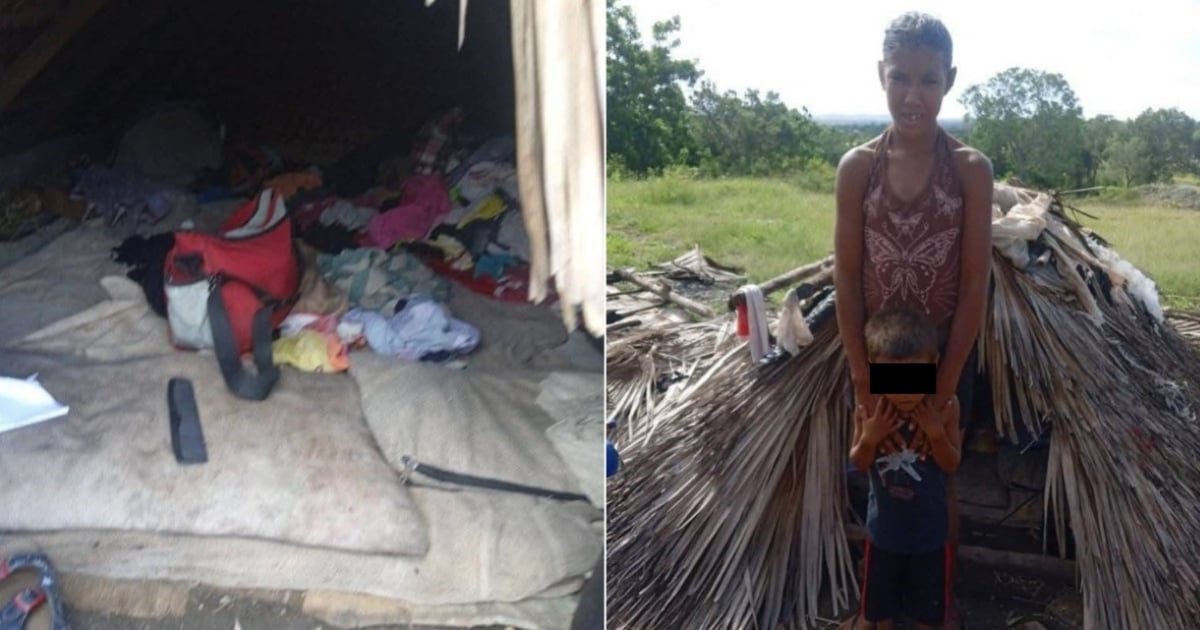
In the small town of San Andrés in Holguín, a disabled mother and her young son are struggling to survive after losing their home to Hurricane Melissa. Despite their dire situation, neither the government nor Civil Defense has stepped in to help.
Exiled doctor and activist Alexander Jesús Figueredo Izaguirre brought attention to their plight through Facebook, highlighting the inhumane conditions they endure in El Llano neighborhood, part of Holguín municipality.
Figueredo described how the pair sleep on bare earth, under a makeshift roof of palm leaves held up by sticks, with no access to clean water, food, or medical care.
The Reality Behind Government Claims
"While the regime boasts of 'victories' and 'revolutionary solidarity,' no one has come to their aid," Figueredo wrote, sharing images of their living conditions and a contact number for those willing to help.
This situation starkly contrasts the government's narrative of recovery following the hurricane's devastation.
As the government and military elite pour resources into hotel renovations and media campaigns, families like this one remain neglected.
Public Outcry and Historical Parallels
"There's no budget for a mattress or a sleeping pad," the doctor criticized, adding that "Cuba is not blocked by anyone but its own dictatorship."
The post sparked a wave of reactions on social media. Users like Karina de los Ángeles Tornés Fonseca recalled the images of rural poverty that Fidel Castro's revolution promised to eradicate, comparing them to the pre-revolutionary Cuba of the 1950s.
Others, including Víctor Pérez and Nani Tower, condemned the systematic neglect and indifference of the state.
"The saddest part is that the mother and her child lived like this even before the hurricane," one user commented, while others demanded justice and urgent assistance.
A Symbol of Neglect
Beyond this individual tragedy, the case epitomizes the abandonment and vulnerability faced by thousands of Cubans in rural areas.
The "varentierra," also known as a bahío, bohío, or ranch, is a traditional rural dwelling built from natural materials like palm, reeds, vines, and logs, constructed directly on the ground with a low, aerodynamic design to withstand hurricane winds.
Prior to Hurricane Melissa's arrival on October 28, Yoel Pérez García, President of the Provincial Defense Council and First Secretary of the Communist Party in Guantánamo, visited the communities of Maca and Casimba in Niceto Pérez municipality to assess the evacuation of families living in such structures.
Government Promises and Public Skepticism
Cuban leader Miguel Díaz-Canel visited several communities in Río Cauto, Granma, heavily impacted by the storm. He assured residents, "No one will be left unprotected," and pledged that "the country will help them rise again."
Díaz-Canel employed poetic and triumphant rhetoric, claiming that Cubans are "as resilient as palms standing against the fiercest winds."
In contrast, a humanitarian initiative for an elderly woman in Juan Vicente, Mayarí, Holguín, went viral online, following a video showing her home utterly destroyed by the hurricane.
In the emotional footage, Pilar, the elderly resident, stands amid the ruins of her home, comforted by two young visitors. Overwhelmed with grief, she asks, "Where will I live, dear? I spend the whole day crying, seeing the state I'm in, seeing my little house," she lamented.
Understanding the Crisis in Rural Cuba
What living conditions are the mother and son facing in San Andrés?
They are living in a "varentierra," sleeping on the ground with a roof made of palm leaves, lacking clean water, food, and medical care.
How has the government responded to their situation?
The government has not provided any aid or response to their plight, despite official claims of recovery efforts.
What is a "varentierra" and why is it significant?
A "varentierra" is a traditional rural dwelling made from natural materials, significant for its resilience to hurricane winds but often lacking basic amenities.