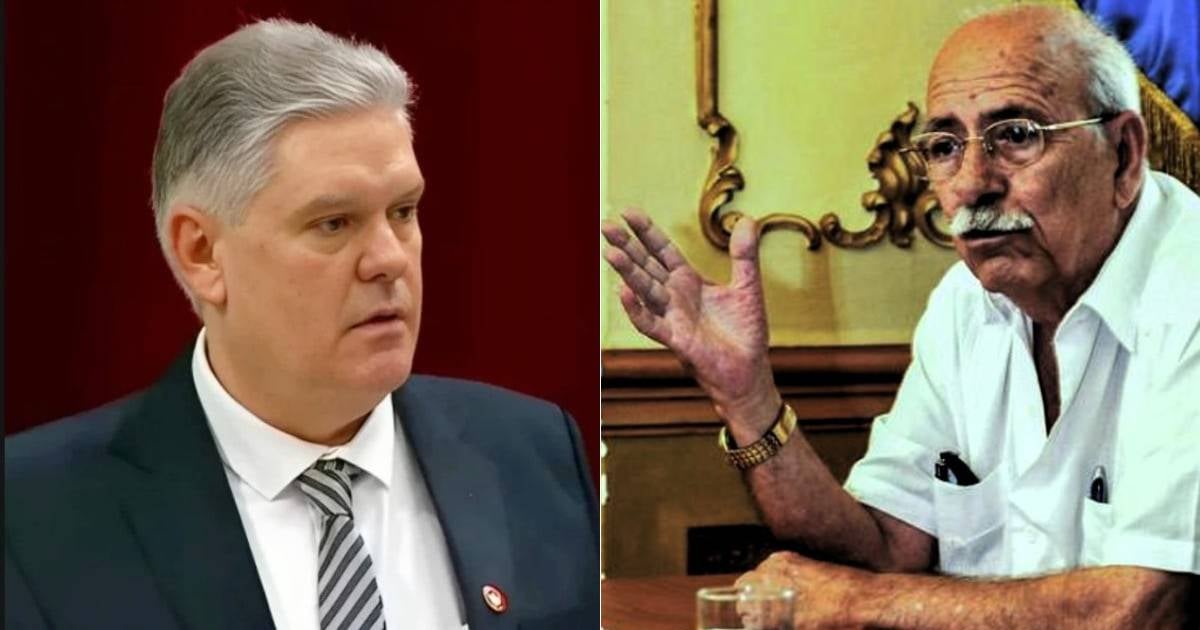
"He is the finest criminal lawyer in Cuba," recently stated María Victoria Gil, the sister of former Economy Minister Alejandro Gil Fernández, as she discussed the attorney tasked with defending her brother in his legal battle over charges of espionage, embezzlement, and money laundering.
In an exclusive interview with CiberCuba, the former Cuban broadcaster disclosed that her brother's defense is in the hands of Dr. Luis Solá Vila, a prominent figure in Cuban law and a man deeply intertwined with the very political system that now stands in judgment against him.
Profile of Luis Solá Vila
Solá Vila serves as the president of the Cuban Society of Public International Law and is a founding member of the National Union of Jurists of Cuba (UNJC). He has also been part of the National Council of this organization, which encompasses much of the state's legal framework.
As a Public International Law professor at the University of Havana, he has held the position of Dean of the Law Faculty and has served as Cuba's ambassador to the United Nations in Geneva. His career in legal advisory roles within Cuban institutions is extensive.
His professional journey has unfolded within the institutional boundaries of the Cuban system. As the legal director for the Executive Committee of the Council of Ministers, an advisor to the Ministry of Communications, and a contributor to the drafting of laws and decrees, he has been directly involved in shaping the legal norms that uphold the regime's structure.
In 2017, he was honored with the Carlos Manuel de Céspedes National Law Award by the UNJC, the most prestigious legal recognition on the island, in a ceremony held at the University of Havana's Great Hall and attended by senior government officials.
Alignment with Official Ideology
Beyond his academic accolades, Solá Vila is known for his staunch support of Cuba's official state discourse. In a 2018 interview with the Cuban News Agency, he championed the island's political system as a "participatory democracy distinct from other nations," and hailed that year's parliamentary elections as "another victory for the Homeland and Socialism."
A year later, at the IX Summer School of International Law and the XII Seminar-Workshop on International Humanitarian Law, he condemned what he called the "violation of the fundamental principles of the United Nations Charter by the United States" and backed Cuba's foreign policy.
A Politically Charged Case
The legal proceedings against Alejandro Gil, a former Deputy Prime Minister and Minister of Economy, have emerged as one of the most politically charged and sensitive trials in recent memory.
Following his removal from office in February 2024, a criminal investigation accused him of severe offenses, including espionage, embezzlement, bribery, forgery of public documents, influence peddling, and money laundering. The prosecution has taken the case to the People's Supreme Court.
In this scenario, the appointment of Luis Solá Vila as Gil's defender presents a paradox, given that the lawyer is also closely connected to the very system that is prosecuting him.
From the Canary Islands, the ex-minister's sister expressed her fears not just of a harsh sentence—"the prosecution is seeking life imprisonment"—but also for her brother's life. "I fear for his life. He could easily be found dead in his cell," she told CiberCuba.
Lack of Judicial Independence
Solá Vila's profile starkly highlights a fundamental issue within the Cuban judicial system: the lack of independence from political power.
The current Constitution subordinates the actions of judges, prosecutors, and defense attorneys to the Communist Party of Cuba, and high-profile political cases, like that of Gil Fernández, are ultimately managed through a lens of control and ideological exemplarity.
Although María Victoria Gil claims to have faith in the lawyer's technical abilities, her son, a criminal lawyer in Spain, cautioned her, "Mom, don't get your hopes up. What can Dr. Solá do against a political decision?"
The answer seems embedded in the defender's career—a prestigious jurist, yes, but one trained and committed within the institutional apparatus now seeking to punish his client.
Laura María Gil González, the daughter of the former economy minister, has publicly called for the trial to be televised and open to the public, invoking constitutional rights to freedom of expression and the defense of honor.
FAQs about the Alejandro Gil Trial
Who is Luis Solá Vila?
Luis Solá Vila is a prominent Cuban lawyer, president of the Cuban Society of Public International Law and a founding member of the National Union of Jurists of Cuba.
What charges is Alejandro Gil facing?
Alejandro Gil is facing charges of espionage, embezzlement, bribery, forgery of public documents, influence peddling, and money laundering.
What are the concerns about the Cuban judicial system?
The Cuban judicial system is criticized for its lack of independence from political influence, with judges, prosecutors, and defense attorneys being subordinate to the Communist Party of Cuba.