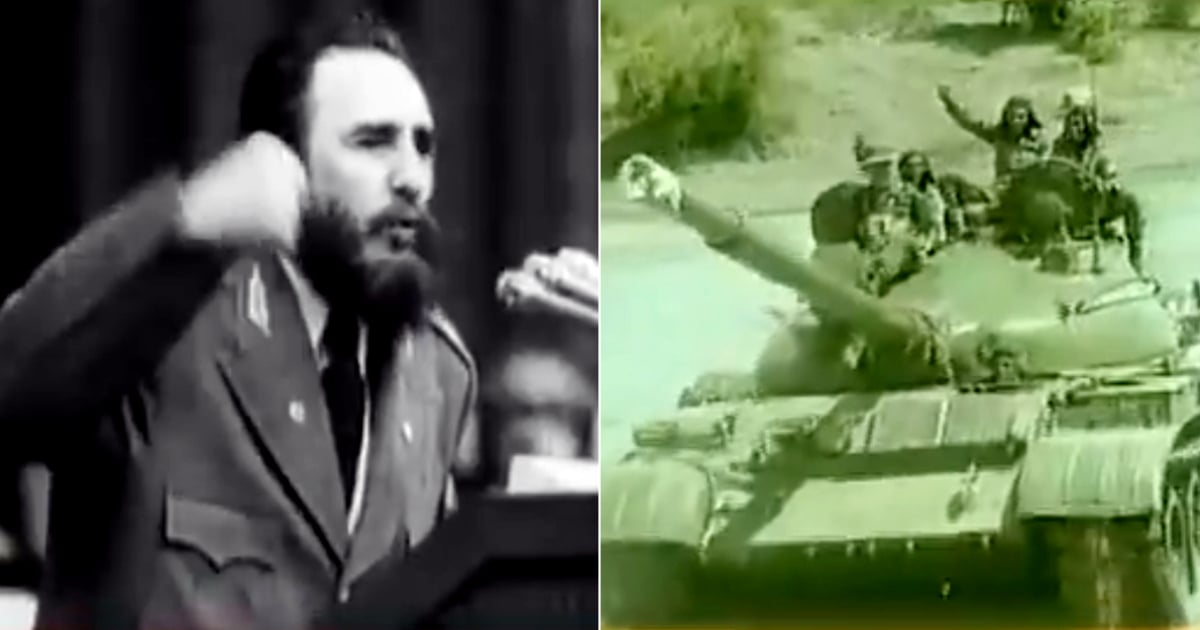
The Cuban Ministry of the Revolutionary Armed Forces (MINFAR) stirred controversy on November 5th after posting a message on the social media platform X (formerly Twitter). The post commemorated the 50th anniversary of Operation Carlota, Cuba's military intervention in Angola.
"November 5th marks the 50th anniversary of Operation Carlota. We secured Angola's independence, contributed to Namibia's, defeated Apartheid, and all we brought back were our dead," the military institution stated.
The phrase "all we brought back were our dead" ignited a wave of anger among Cubans both on the island and abroad. One user responded sharply:
"They weren't 'your' dead. They were the sons of Cuban families, thousands of whom mourned in silence, never received any compensation, and today live in extreme poverty. And yes, you brought back more: natural resources and influence that consolidated the dictatorship's power."
This statement from the MINFAR, far from honoring the fallen, resonated as an appropriation of grief.
State Control Over Personal Loss
Referring to the fallen as "our dead"—as if they belonged to the state rather than their families—summarizes how the Cuban regime has manipulated the sacrifice of thousands of young people sent to foreign wars under the guise of "proletarian internationalism" for half a century.
Operation Carlota, launched in November 1975, was the code name for Cuba's military intervention in the Angolan civil war, where Fidel Castro's regime supported the Soviet-backed Popular Movement for the Liberation of Angola (MPLA).
A Costly and Ideological Conflict
The official pretext was "internationalist solidarity" and the "moral duty" to aid an African country's independence. However, the reality was a prolonged, ideological, and costly war, part of the Soviet strategy in Africa during the Cold War.
According to Cuban sources and historical documents:
- Over 300,000 Cubans were involved in military or civilian missions in Africa, notably in Angola, Ethiopia, and Mozambique.
- Estimates of Cuban casualties range from 2,000 to 10,000; the regime officially acknowledges 2,085 military and 204 civilian deaths.
- Operation Tribute in 1989 repatriated some remains, but many families never received information or compensation.
- Tens of thousands returned home wounded, maimed, or as veterans without real recognition or assistance.
Those "dead" the MINFAR spoke of were not theirs: they were sons, brothers, and fathers from humble families, many recruited without full awareness of the conflict, indoctrinated in an ideological narrative that turned them into pawns in a geopolitical game.
Altruism Myth and Power Gains
For decades, Castro's regime portrayed its African interventions as the ultimate example of "internationalist solidarity." Yet the facts, documents, and outcomes reveal it was not merely altruism but a politically, economically, and propagandistically orchestrated operation.
1. A Geopolitical Tool for the Soviet Bloc
Cuba acted as the Soviet Union's military arm in Africa, with logistical support, arms, and Soviet air and naval transport.
In return, Moscow economically compensated Havana's regime with subsidized oil, soft loans, and annual aid that, between 1986 and 1990, exceeded $4.3 billion yearly, equivalent to 20% of Cuba's GDP at the time.
In essence, Cuba provided the dead; the USSR provided the money and weapons.
2. Political and Diplomatic Leverage
The military involvement in Africa gave Havana a significant role in the Non-Aligned Movement and the United Nations, securing African votes in favor of the Cuban regime on resolutions against the U.S. embargo and other international issues.
Fidel Castro used this symbolic capital to portray himself as a leader of the "socialist Third World."
3. Long-term Economic Benefits
After military withdrawal, Angola and other African countries hired thousands of Cuban doctors, engineers, and technicians under state agreements.
Companies like Antex managed these services, retaining up to 80% of the payments, generating between $4.8 and $9.6 billion in revenue for the Cuban state.
Meanwhile, the collaborators received minimal salaries and were subject to political oversight.
Thus, what began as "proletarian internationalism" ended as a state business and diplomatic tool.
The Human Cost of Silence
The phrase "all we brought back were our dead" erases the tragedy behind each urn. Thousands of Cuban families wept in silence, unable to publicly discuss the pain or the absurdity of that war.
Some mothers died without knowing where their son fell. Others received medals, diplomas, and slogans but never a decent pension or sincere acknowledgment.
The Cuban state never allowed a public debate on the human and moral consequences of Operation Carlota. Nor did it recognize the instrumentalization of these young people, used as cannon fodder in a foreign ideological contest.
Today, half a century later, many of those families live in poverty, while the high-ranking officials who sent them continue to hold positions or receive honors, perpetuating that rhetoric and those practices.
Propaganda with Others' Sacrifices
The MINFAR tweet highlights a persistent theme in Cuban politics: the appropriation of collective sacrifice to sustain a heroic narrative of the regime.
"We brought back our dead" is not a tribute; it's a confession of power. A power that considers even the lives and deaths of its citizens as state property.
Official history presents Operation Carlota as a victory. But for thousands of Cuban families, it was an irreparable loss and a historical lie: a distant war, without their own cause, that fortified the regime's power and filled the island's poorest neighborhoods with grief.
Fifty Years On
Half a century later, the regime continues to celebrate a feat that is not theirs.
The true protagonists—the soldiers, teachers, doctors, those who never returned—are not part of the power that invokes them but victims of it.
And while the MINFAR claims "all we brought back were our dead," the Cuban people continue to bear their own: nameless dead, without known graves, without justice, and without a voice.
The MINFAR tweet is not just a communicative blunder; it's a reflection of the contempt with which the Cuban regime has always treated its own people.
Turning a national tragedy into a propaganda slogan is perhaps the greatest offense a state can commit against its people.
Understanding the Impact of Operation Carlota
What was Operation Carlota?
Operation Carlota was the code name for the Cuban military intervention in the Angolan civil war, which began in November 1975. It involved supporting the Soviet-backed MPLA in Angola.
How many Cubans participated in missions in Africa?
More than 300,000 Cubans were involved in military or civilian missions in Africa, with a significant presence in Angola, Ethiopia, and Mozambique.
What was the economic exchange between Cuba and the Soviet Union during the interventions?
The Soviet Union compensated Cuba with subsidized oil, soft loans, and substantial annual aid, which between 1986 and 1990 amounted to over $4.3 billion per year, roughly 20% of Cuba's GDP at the time.
What was the human cost of Operation Carlota for Cuba?
Thousands of Cubans died, with estimates ranging from 2,000 to 10,000. Many families never received information or compensation, and numerous veterans returned without recognition or support.