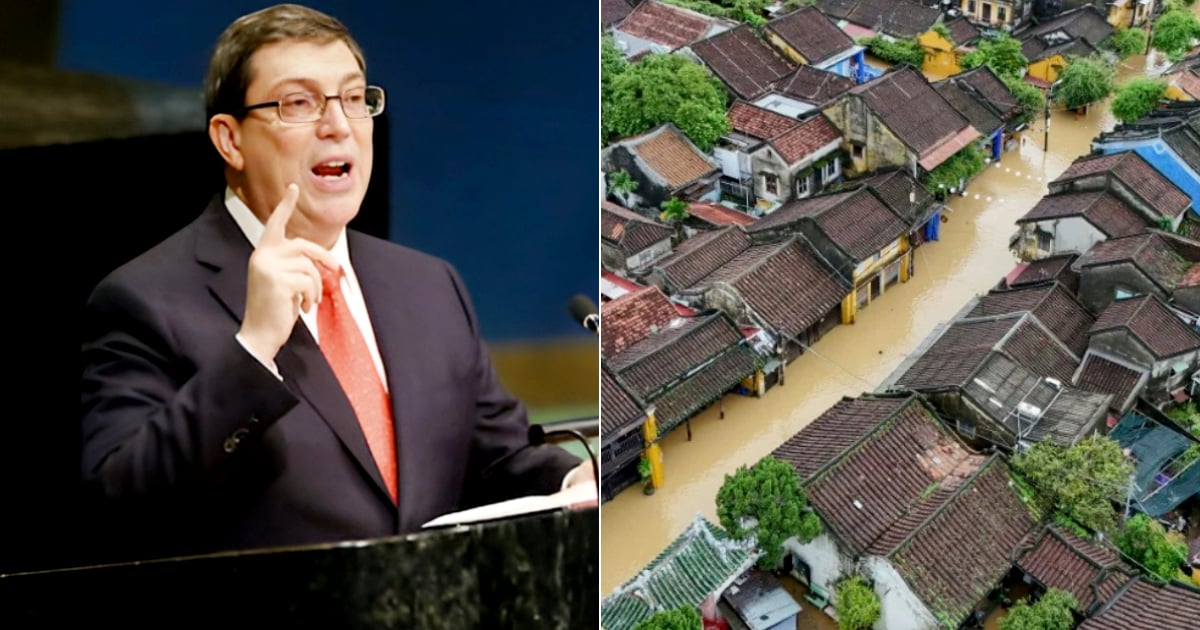
Once again, Cuban Foreign Minister Bruno Rodríguez Parrilla has tapped into one of the regime's long-standing propaganda tactics: leveraging the hardships of others to highlight the alleged humanitarian and moral superiority of the so-called “revolution.”
In a post shared on X (formerly Twitter), Rodríguez Parrilla expressed his "solidarity and support" for the government and people of Vietnam in light of recent floods that resulted in numerous casualties and missing persons.
While this gesture appears diplomatic, it coincides with Cuba's ongoing recovery from Hurricane Melissa, which caused significant damage to homes, agriculture, and power grids. The government claims there were no deaths, but reports mention two individuals missing after being swept away by a swollen river. Social media is rife with complaints about communities left isolated and without state assistance.
On the surface, Rodríguez Parrilla's condolences might seem like routine diplomatic conduct. However, within the context of the Cuban regime’s narrative during natural disaster recoveries, these statements are part of a well-orchestrated strategy.
Turning Tragedy into Propaganda
For decades, the Havana leadership has turned foreign tragedies into mirrors reflecting their claimed ethical and organizational superiority. Each time a hurricane strikes the Caribbean or Southeast Asia, state media resurrects the narrative that “no one dies in Cuba” due to its civil defense model, collective discipline, and the leadership of the Communist Party (PCC).
This narrative, reiterated over generations, is used to bolster the moral legitimacy of a system in a perpetual state of collapse. Instead of assuming responsibility for structural deficiencies, the government frames its endurance as a moral achievement and its poverty as a virtue.
The Calculated Message of Condolences
Rodríguez Parrilla, a steadfast mouthpiece of the regime, echoes this rhetoric with the precision of an official shaped by the indoctrination and propaganda of the PCC's “good old days,” now under the leadership of Yuniasky Crespo Baquero during these deteriorating “continuity” times.
His message to the “people of Vietnam” is less a gesture of goodwill and more an attempt to assert that Cuba remains a global exemplar—even amid prolonged blackouts, drug shortages in hospitals, rampant inflation, and one of the most significant migration crises in its recent history.
In practice, the regime projects compassion outward to justify its internal apathy. It speaks of the pain of other nations while ignoring the daily suffering of Cubans, who endure scarcity, neglect, and hopelessness.
While boasting of humanity abroad, the real emergency within Cuba — social, economic, and humanitarian — continues without condolences or accountability.
Understanding Cuban Propaganda Tactics
Why does the Cuban regime use foreign disasters in its propaganda?
The regime leverages foreign tragedies to assert its moral and organizational superiority, diverting attention from its internal failures and presenting its endurance as a moral victory.
How does the Cuban government portray its response to disasters?
The government claims that its civil defense model and collective discipline ensure no fatalities occur during disasters, using this narrative to reinforce the moral legitimacy of its system.