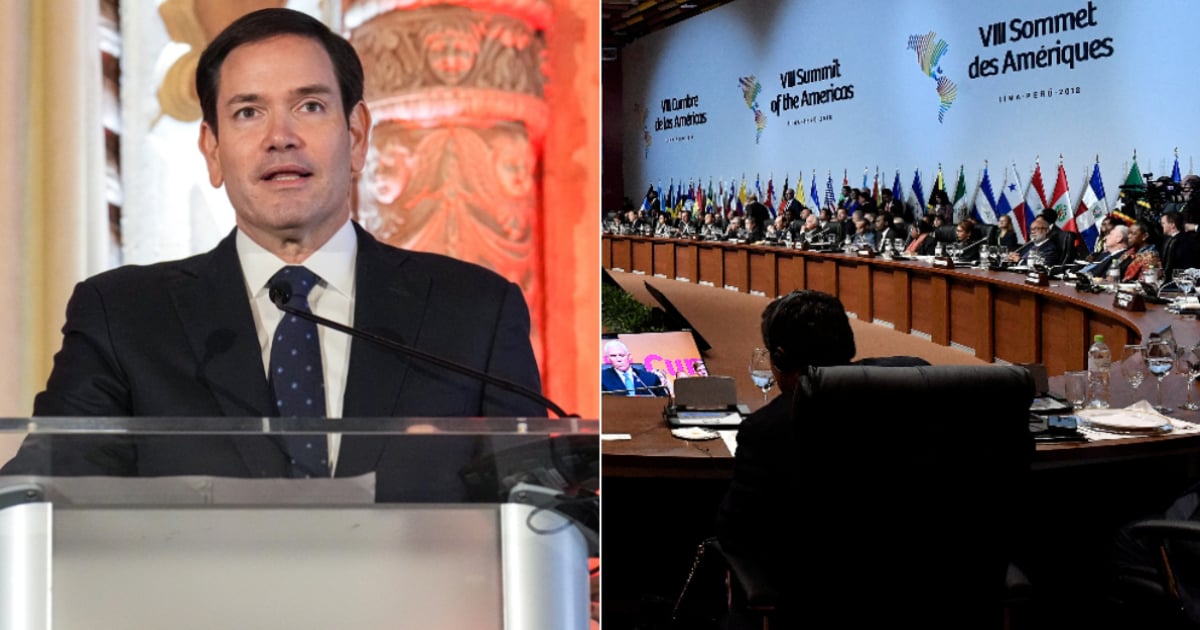
The Dominican Republic has decided to postpone the Tenth Summit of the Americas, originally scheduled for December 1-5 in Punta Cana, citing the lack of "appropriate conditions" for hosting this major hemispheric forum.
This decision was made by President Luis Abinader’s government following discussions with regional partners and has the backing of the United States, which was a key promoter of the event.
U.S. Secretary of State Marco Rubio expressed his approval of the postponement via a post on the social media platform X. He thanked the Dominican president for his "friendship and willingness" and assured that Washington would collaborate with Santo Domingo and other nations to organize a productive event in 2026, focused on strengthening alliances and enhancing citizens' security.
Although the official reason for postponing the summit was "regional disagreements" and the impact of recent natural disasters in the Caribbean, diplomatic sources quoted by El Tiempo and CNN suggest that the real issue is the current political and military tensions affecting the hemisphere. This includes the deployment of U.S. forces in the Caribbean and deteriorating relations with Venezuela.
Since August, the U.S. has stationed more than ten warships and several fighter jets in Caribbean waters as part of an "anti-narcotics" operation, which, according to media reports, has involved 14 bombings of suspected vessels, resulting in at least 62 casualties.
While the White House insists these actions target drug trafficking, various governments and analysts argue that the campaign aims to increase military pressure on Nicolás Maduro's regime.
President Donald Trump has declared that "all options are on the table," a statement that inflames tensions with Caracas and raises concerns among Venezuela's allies, especially Russia, which condemned the U.S. deployment as "an excessive use of force" and confirmed its ongoing cooperation with the Venezuelan government.
Under these circumstances, hosting a multilateral summit in Santo Domingo under the Organization of American States (OAS) — near where U.S. naval forces operate — would be politically explosive.
A Dominican diplomat, speaking to Listín Diario on condition of anonymity, admitted, "There were no guarantees of security or political neutrality; Santo Domingo would have been at the eye of the storm."
Furthermore, the Summit was already fraught with diplomatic controversies. The Dominican Republic had chosen not to invite Cuba, Nicaragua, and Venezuela, aligning with Washington's stance from 2022, when those countries were excluded for human rights violations.
This decision drew reactions from various Latin American governments, including those of Mexico and Colombia. Leaders Claudia Sheinbaum and Gustavo Petro announced their boycott of the event in protest.
With several leaders boycotting, the summit risked becoming a sparsely attended forum, which would have been a political setback for Abinader, who aims to portray the Dominican Republic as a stable mediator. Diplomats consulted agree the postponement was a preventive measure to avoid a diplomatic failure.
From Washington, State Department sources informally acknowledged that "limited participation" was a decisive factor. A spokesperson stated that the U.S. "supports the Dominican decision to postpone the Summit until conditions are more favorable for consensus."
Analysts agree that the postponement is a tactical pause by Washington and its allies, a way to buy time as strategies are redefined in response to the Venezuelan crisis and political shifts in Latin America.
The electoral landscape in countries like Colombia and Mexico, where upcoming elections might alter the regional power balance, also plays a role.
For now, the Summit is rescheduled for 2026, with the goal of mending diplomatic bridges and preventing the forum from becoming a scene of open confrontation.
Meanwhile, the ongoing tensions between Caracas and Washington, the military build-up in the Caribbean, and the political division among continental governments reveal a more fragmented hemisphere than ever.
As a Latin American ambassador in Washington pointed out to El Tiempo, "It is a bad sign that, facing a crisis of this magnitude, the hemisphere can't even come together for dialogue. If the Americas Summit isn’t the place for conversation, where will it happen?"
Key Questions About the Americas Summit Postponement
Why was the Americas Summit in the Dominican Republic postponed?
The Summit was postponed due to inadequate conditions, regional disagreements, and the impact of recent natural disasters, alongside political and military tensions in the hemisphere.
What role did the United States play in the postponement of the Summit?
The United States supported the Dominican Republic's decision to postpone the Summit, citing limited participation and the need for more favorable conditions for consensus.
What are the implications of the postponed Summit for regional politics?
The postponed Summit reflects ongoing political and military tensions, with the postponement seen as a tactical move to reassess strategies amid shifting dynamics in Latin America.