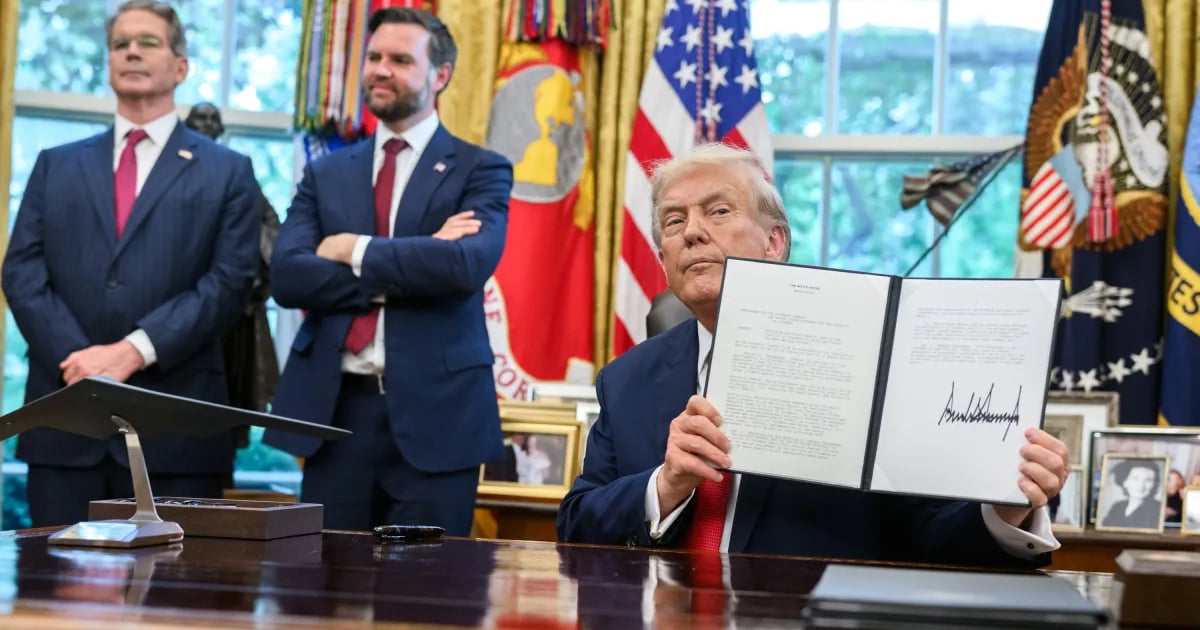
As President Donald Trump gears up for the upcoming midterm elections, he confronts a nation deeply divided and a widespread lack of approval, despite having a Republican bloc that's more unified than ever before.
According to a survey conducted by The Washington Post, ABC News, and Ipsos, a significant 59% of Americans disapprove of Trump's performance, while only 41% express support.
Nevertheless, a solid 86% of Republican voters continue to back the president, whereas 95% of Democrats and 69% of independents disapprove of him.
Polarization and Disengagement
The country finds itself in a deadlock due to extreme polarization. If the legislative elections were held today, 46% would choose a Democrat, and 44% would lean toward a Republican, as indicated by the same poll.
Interestingly, the most revealing statistic isn't about polarization but rather disengagement: 68% of Americans believe Democrats are "out of touch with reality," and 63% feel the same way about Trump.
Neither the president nor the opposition seems to inspire confidence, suggesting that the upcoming election might be driven more by disenchantment than by hope.
The Challenge of Political Fatigue
"Political fatigue is the new adversary for Democrats," the Ipsos report concluded. "Dissatisfied voters don't necessarily mobilize against Trump; many simply disconnect from the process."
While Republicans hold a narrow majority in the House of Representatives, Democrats aim to regain ground in 2026. However, Trump retains a structural advantage: his supporters are notably loyal and more likely to vote.
Nine out of ten supporters of Trump's administration say they'll vote Republican, whereas only eight out of ten who disapprove of him plan to vote Democrat.
Shifting Priorities and Voter Concerns
According to the Pew Research Center, only 50% of Americans currently view Russia as a "direct enemy," a significant drop from 2022.
This shift highlights a change in voter priorities, with a greater focus on the economy and domestic security rather than foreign policy. This focus could benefit Trump, despite his international setbacks.
With high inflation rates, immigration at the forefront of debates, and a nation divided over its president, the United States is bracing for unpredictable midterm elections where every vote matters, and apathy might emerge as the biggest winner.
Why the 2026 Midterms Matter for Trump's Political Future and U.S. Democracy
The November 2026 legislative elections are more than a routine political event in the U.S.; they serve as a referendum on Donald Trump's power and the health of the nation's institutional democracy.
In this election, all 435 House of Representatives seats and about 35 of the 100 Senate seats will be contested, along with several governorships, secretaries of state, and attorneys general in various states. This is a pivotal moment for voters to reshape the balance of power between the White House and Congress.
Currently, the Republican Party holds a slim majority in the House, while the Senate is nearly evenly split, with a slight Republican advantage that has allowed Trump to push part of his executive agenda with few hurdles.
Institutional Concerns and the Balance of Power
However, the survey by The Washington Post, ABC News, and Ipsos reveals a critical insight: 64% of Americans believe Trump has overstepped his presidential powers, and a majority think Congress should exercise more control over his decisions.
This institutional distrust makes the 2026 midterms an election about balance of power: a scenario where voters may seek to set limits on the executive branch rather than reward or punish a particular party.
The Political Climate Test of 2025
The elections held this Tuesday (November 4, 2025) in Virginia and New Jersey, along with the New York City mayoral race, have been seen as a preview of the electoral climate that could prevail in 2026.
In Virginia, where Republicans aimed to solidify their legislative control, preliminary results reveal a tight race, with Democrats regaining ground in key suburban districts. In New Jersey, Democrats retained the governorship, but with a narrower margin than in previous cycles, indicating a less mobilized opposition base.
These local elections, alongside those in Kentucky and Mississippi, have served as a testing ground to gauge the impact of Trumpism beyond the federal realm. Trends suggest that while Trump maintains a loyal base, independents and moderates continue to seek a counterbalance.
What's at Stake in 2026?
House of Representatives (435 seats): If Democrats manage to win at least twenty currently Republican-held districts, they could regain the majority and curb or review Trump's executive orders, many of which have sparked judicial and political controversy.
Senate (35 seats): Republicans will defend several seats in battleground states like Pennsylvania, Wisconsin, and Nevada. Losing just two seats could return Senate control to Democrats, directly affecting judicial nominations and foreign policy.
State Elections: At least 11 states will elect governors, including Delaware, Indiana, Missouri, Montana, North Carolina, Utah, Vermont, Washington, and West Virginia. State control is crucial for electoral administration, immigration policy, and redistricting.
The Risk of Institutional Imbalance
The Washington Post and ABC News emphasize that a majority of Americans believe Congress should limit presidential overreach.
This sentiment has intensified after a year in which Trump used executive orders to alter federal structures, intervene in universities, and deploy National Guard troops in cities without gubernatorial approval.
The Supreme Court has yet to rule on several of these measures, but public opinion seems clear: 64% think Trump abuses his authority.
Thus, the 2026 elections might become more about checks and balances than partisan loyalty: an effort by many voters to prevent unchecked power in an executive branch leaning towards rule by decree.
"These midterms will be a test not just for Trump, but for the system," noted an Ipsos analysis. "If Congress remains complacent, American democracy risks losing its ability to check and balance power."
Conclusion
In a nation where most disapprove of the president (59%), yet the opposition fails to inspire trust, the 2026 elections are shaping up to be a contest between institutional integrity and the concentration of power.
Trump enters with a solid political base within the Republican Party, but with a citizenry that — according to the same poll — demands clear limits on his authority.
This could be the key to the next electoral cycle: not just who governs the United States, but how and under what democratic controls they do so.
FAQs on the 2026 Midterm Elections
What is the significance of the 2026 midterm elections?
The 2026 midterm elections are crucial as they serve as a referendum on Donald Trump's presidency and the state of U.S. democracy. They will determine the balance of power between the White House and Congress.
How might voter priorities influence the 2026 elections?
With changing priorities focusing more on the economy and domestic security, these issues may play a significant role in shaping voter decisions, potentially benefiting Trump despite his international challenges.
Why is there concern over Trump's use of executive powers?
Many Americans believe Trump has overstepped his presidential powers, prompting a call for Congress to impose limits. This concern could lead voters to prioritize checks and balances in the 2026 elections.