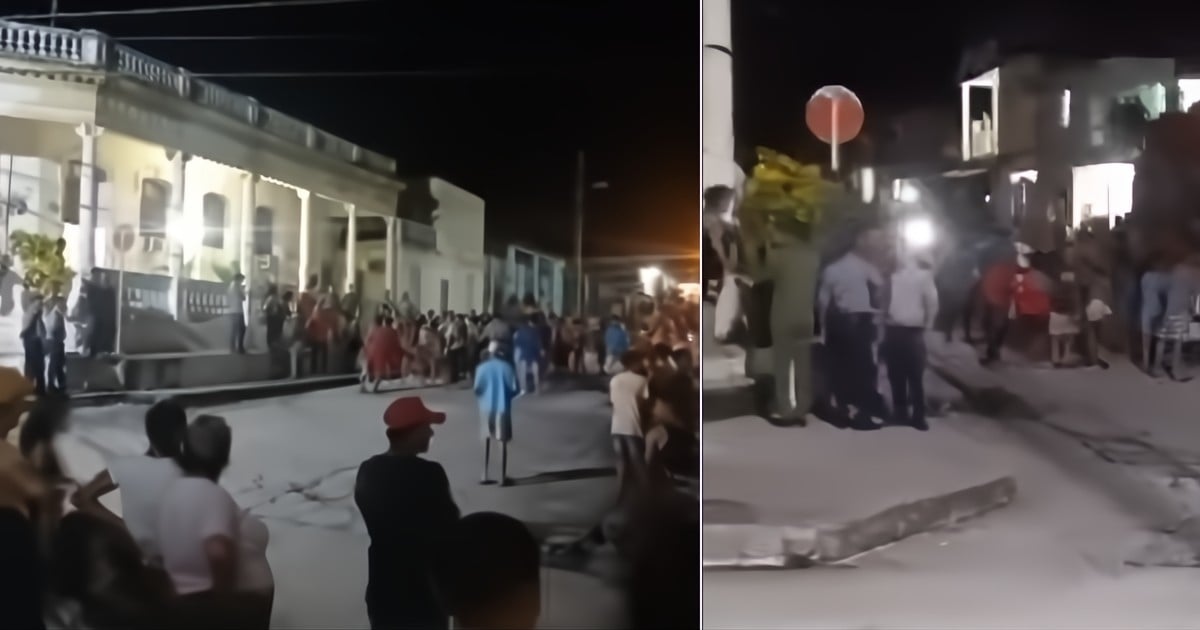
A Cuban court has handed down sentences of up to six years in prison to six individuals for their involvement in a peaceful protest involving "banging on pots and other metal objects" outside the municipal government headquarters in Manicaragua. The demonstrators were demanding the restoration of electricity during a power outage.
The Cuban Observatory for Human Rights (OCDH) reports that the Villa Clara Provincial Court's Sentence C725, dated October 20, 2024, categorizes the actions as crimes against public order. In one instance, the charges also included propaganda against the constitutional order, according to documents accessed by the OCDH.
José Águila Ruiz received a six-year sentence for propaganda against the constitutional order, while Raymond Martínez Colina and Carlos Hurtado Rodríguez were sentenced for public disorder.
Others, including Osvaldo Agüero Gutiérrez, Narbiel Torres López (18 years old), and Yoan Pérez Gómez, received five-year sentences, also for public disorder.
Additional penalties were imposed, such as the deprivation of political rights and travel bans.
The Night of Protest and Its Aftermath
On the evening of October 20, 2024, over 100 people gathered in front of the Manicaragua Municipal Assembly of People's Power, banging pots and shouting "we want electricity" to demand the resumption of power services.
Once the electricity was restored, the protest dispersed without any major incidents, as acknowledged by the court's own ruling.
Legal and Human Rights Concerns
The ruling states that the defendants "disturbed public peace" by blocking the street and disrupting traffic.
Narbiel Torres was accused of using a horn to incite noise, Raymond Martínez of striking a metal object around his waist, and Carlos Hurtado of making similar noises. Other defendants allegedly shouted and gestured, preventing officials from explaining the energy situation.
José Águila Ruiz was criticized for filming and live-streaming the protest with the intent to "discredit the Cuban social system."
The OCDH condemned the verdict as a "fraud" aimed at criminalizing civic protest amid a crackdown on dissent.
They highlighted due process violations, poor legal rationale, and a lack of objective evidence to substantiate the charges, arguing that the defendants should have been acquitted and released immediately.
Furthermore, the OCDH criticized the indiscriminate identification of defendants in the crowd, over-reliance on testimonies from MININT and local officials, and politically biased language that undermines judicial impartiality.
The Broader Implications
The State Security Crimes Chamber was composed of Justo Gustavo Faife Hernández (rapporteur), Noraimis Blanco Echarte, and Ricardo Hernández Domínguez, with prosecutor Yoenys Montero Tamayo.
Although the defense may appeal the decision, the OCDH warns that the ruling is intended to curtail freedoms of expression and assembly, effectively nullifying constitutional rights to complaint and petition.
The Manicaragua case exemplifies how everyday dissent—such as protests over power cuts and basic services—is penalized with severe sentences and additional restrictions beyond the main punishment.
Human rights organizations argue that such decisions increase the cost of peaceful protest and deter citizens from voicing grievances over service and public management failures.
Frequently Asked Questions About Legal Repercussions for Protests in Cuba
What were the charges against the protesters in Manicaragua?
The protesters were charged with crimes against public order, and in one case, propaganda against the constitutional order.
How has the OCDH responded to the court's decision?
The OCDH denounced the verdict as a fraudulent attempt to criminalize civic protest, highlighting numerous due process violations and a lack of evidence.
What additional penalties were given to the protesters?
Besides prison sentences, the court imposed penalties such as deprivation of political rights and travel bans.