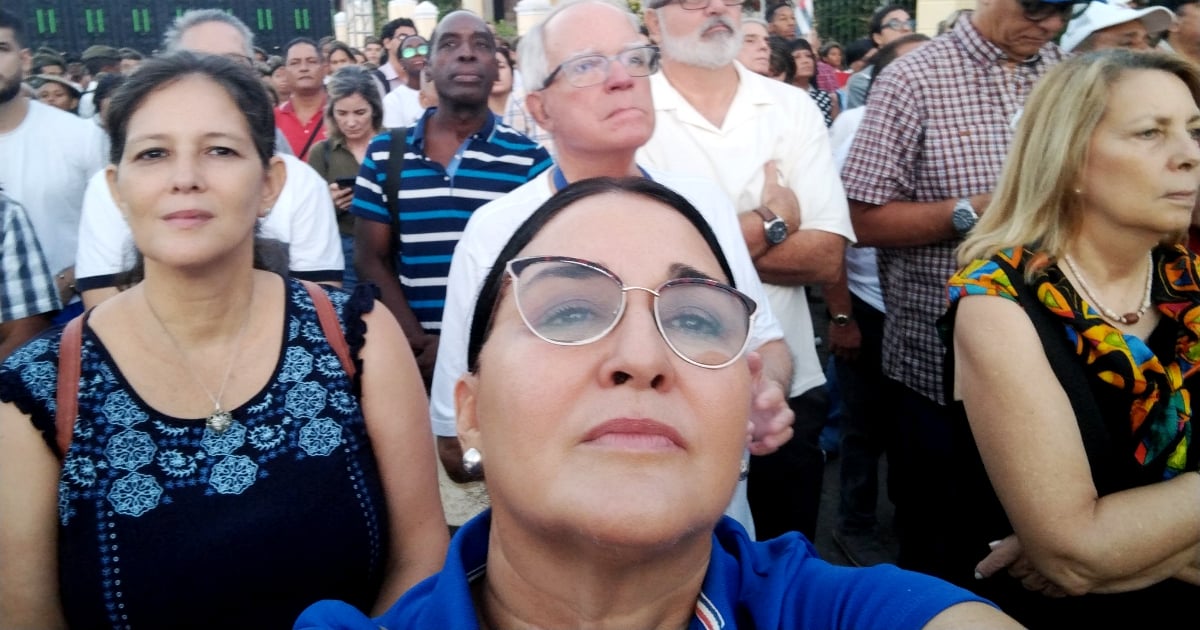
Renowned Cuban diplomat Johana Tablada de la Torre, well-known for her staunch support of the Havana regime and her consistent criticism of the United States, made a return to social media this past Sunday. Her comments were directed at the sweeping "No Kings" demonstrations that have been occurring across multiple American cities in recent days.
In a statement posted on her Facebook account, the official from the Ministry of Foreign Affairs (MINREX) remarked, “While the [U.S.] ‘Embassy’ lectures us morally to justify the criminal blockade that punishes us with malice... over there, the people are not very happy with their government’s policies.”
Appointed by the Cuban leader Miguel Díaz-Canel, Tablada showed no hesitation or moral reservation in applauding the public dissatisfaction manifesting in the American democracy. This stands in stark contrast to her reactions to Cuban citizens protesting against their own government, often dismissing them as acts of manipulation, servility, and unconstitutional chaos perpetrated by criminals, drunks, and mercenaries of the "empire."
The Irony of a Cynical Diplomat
Tablada, who recently ascended from her role as deputy director-general for the U.S. at MINREX, remains a fervent advocate for Cuba’s oppressive regime, notorious for quashing any hint of dissent and imprisoning those who dare to exercise basic freedoms like assembly or speech. Her comments have been seen as paradoxical—and even insulting—by many, given that she represents a government that imprisons, assaults, and defames its own citizens for protesting.
In Cuba, any citizen movement not sanctioned by the Communist Party is branded as a "counterrevolutionary provocation." Such was the case with the July 11th, 2021 protests, where hundreds of thousands of Cubans took to the streets demanding "freedom" and "food," only to be met with police violence, swift trials, and lengthy sentences.
Since those events, Tablada has publicly defended the regime's actions, labeling them as a "legitimate response to vandalism," and echoing the official narrative that the protesters were "manipulated by the United States."
Double Standards and State Propaganda
Tablada's remarks fall under the longstanding strategy of Cuban propaganda: exploiting social conflicts in the United States to create a false moral equivalence between an imperfect democracy, where citizens can protest without fear of imprisonment, and a totalitarian dictatorship where even the mere organization of a peaceful march can lead to imprisonment.
In the U.S., millions can march against their president without fear of retaliation, while in Cuba, a critical Facebook post can result in years behind bars on charges of "disrespect" or "enemy propaganda." The difference is stark, though Tablada attempts to blur it with rhetoric straight from the Ñico López school of thought.
The contrast is even more glaring considering that Cuba ranks 173 out of 180 countries in the World Press Freedom Index by Reporters Without Borders, while the United States is at 42. In Cuba, all media outlets are state-owned, internet access is monitored, and independent journalists are harassed, defamed, or forced into exile.
Tablada de la Torre's statements also starkly contrast with Cuba's position in major international indices on human rights and civil liberties. According to Freedom House's Freedom in the World 2025 report, the island is categorized as "not free," scoring a mere 10 out of 100, with 1 out of 40 in political rights and 9 out of 60 in civil liberties.
Human Rights Watch's World Report 2025 describes Cuba as a state maintaining a widespread repressive system, characterized by arbitrary detentions, torture, censorship, persecution of journalists and activists, and a lack of judicial independence.
The U.S. State Department has described the situation as "critically restrictive," highlighting "enforced disappearances, harassment, and the prohibition of independent unions." In summary, Cuba finds itself at the lower end of all human rights rankings in the hemisphere.
Diplomacy as an Echo of Repression
In recent years, Tablada has been at the center of several controversies. She has defended the jailing of journalists, blamed Washington for the migration crisis, and even applauded on national television when an "expert" claimed that "there is more freedom of expression in Cuba than in the United States."
The U.S. State Department has openly labeled her as a "puppet of the Cuban dictatorship," a description befitting her role as a disciplined spokesperson for the Castro regime on the international stage.
Her recent comment on the U.S. protests fits into a pattern of discourse aimed at relativizing internal repression, attacking Washington, and reinforcing the narrative of revolutionary victimhood. However, the irony of her message only highlights what she tries to conceal: in Cuba, people are not just unhappy with their government, but expressing it comes at a devastating cost.
Because if there is one thing that distinguishes American protesters from Cuban ones, it is that in one country they protest with megaphones, and in the other, with fear.
Cuban Diplomacy and Human Rights: A Closer Look
What did Johana Tablada say about the U.S. protests?
Johana Tablada commented on the "No Kings" protests in the U.S., stating that Americans are not happy with their government's policies, while critiquing the moral lessons from the U.S. Embassy.
How does Johana Tablada's stance on protests differ between Cuba and the U.S.?
Tablada applauds American protests as a sign of dissatisfaction, while dismissing Cuban protests against the regime as manipulations by criminals and foreign mercenaries.
What is the state of press freedom in Cuba compared to the U.S.?
Cuba ranks 173 out of 180 in the World Press Freedom Index, with all media controlled by the state, while the U.S. stands at 42, with a significantly freer press environment.