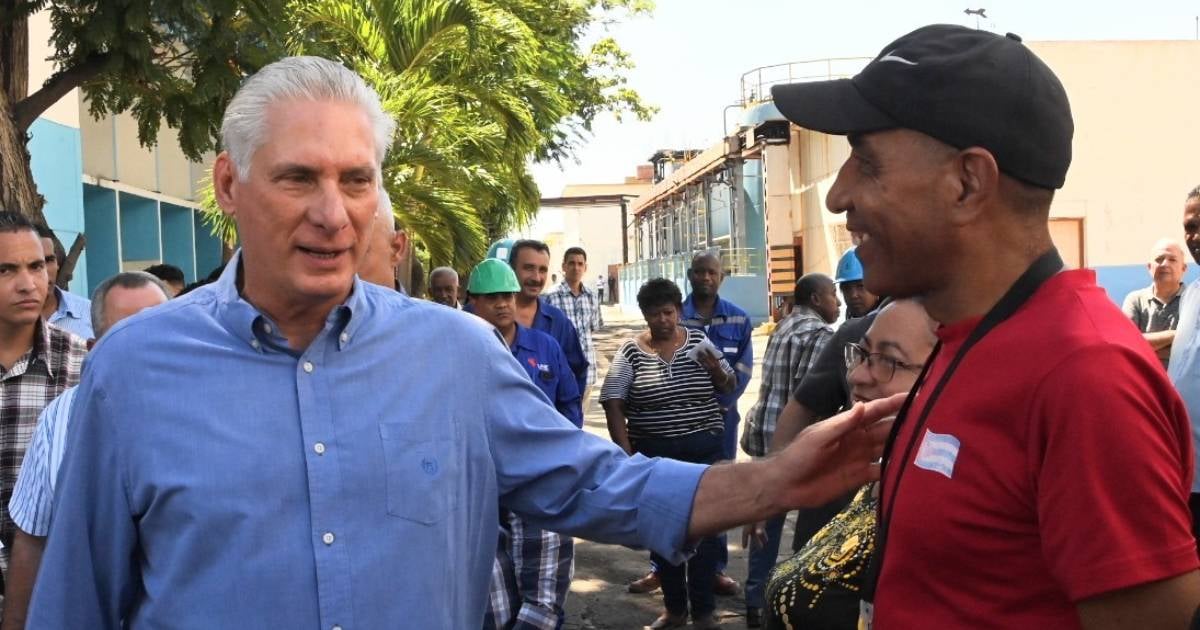
Cuban leader Miguel Díaz-Canel declared on Thursday that the Antonio Maceo Thermoelectric Plant, known as Renté, in Santiago de Cuba, would achieve "stability" before the end of 2025. This statement comes despite the plant being emblematic of the National Electric System's (SEN) decline. During his visit to the facility, Díaz-Canel emphasized the importance of ensuring quality maintenance on units 3, 5, and 6, and urged efforts to "regain power" to provide more electricity by the year's end.
While he acknowledged the hard work of the electrical workers and defended his government's strategy of combining repairs with the construction of new solar parks, the promise of stability starkly contrasts with Renté's recent history marked by power outages, breakdowns, and human tragedies.
Enduring Crisis at the Plant
Unit 5 of Renté was shut down on September 24 due to a water station leak, just days after resuming operations following a furnace failure. That same week, a fire in the fuel oil generator units mobilized firefighting brigades and endangered auxiliary facilities' safety.
Earlier, at the end of August, the plant witnessed a severe workplace accident. A young operator, Carlos Rafael López Ibarra, aged 33, suffered burns on 89% of his body during the startup of unit 5 and tragically passed away days later in the hospital, leaving his coworkers and neighbors in shock.
Official reports have also confirmed the repeated disconnection of unit 3 due to "low vacuum" technical failures, depriving one of eastern Cuba's most vital thermoelectric plants of a stable contribution.
Unrelenting Blackouts
As Díaz-Canel pledges recovery, the Electric Union acknowledges generation deficits exceeding 1,700 megawatts during peak hours, with impacts lasting 24 hours in several provinces and blackouts extending over 20 hours daily.
The sporadic return of units like Renté 5 offers brief relief but fails to resolve what specialists describe as an outdated system lacking spare parts and with over four decades of operation.
Díaz-Canel's visit to Renté aims to instill confidence in a sector burdened by public discontent and government discredit. However, the daily reality for Cubans involves disconnected refrigerators, dark hospitals, children studying by candlelight, and entire neighborhoods without power for most of the day.
Promising stability from a thermoelectric plant plagued by fires, breakdowns, and workplace deaths not only seems untenable but also widens the gap between official rhetoric and a population trapped in the uncertainty of incessant blackouts.
Understanding Cuba's Power Crisis
What issues have plagued the Renté power plant?
The Renté power plant has experienced frequent breakdowns, fires, and a tragic workplace accident, highlighting its operational instability.
How has the power crisis affected Cuban citizens?
Cubans face daily hardships such as extended blackouts, lack of refrigeration, and children studying in inadequate lighting conditions.
What does the Cuban government propose to address the power issues?
The government plans to combine maintenance of existing units with the development of new solar parks to enhance electricity supply.