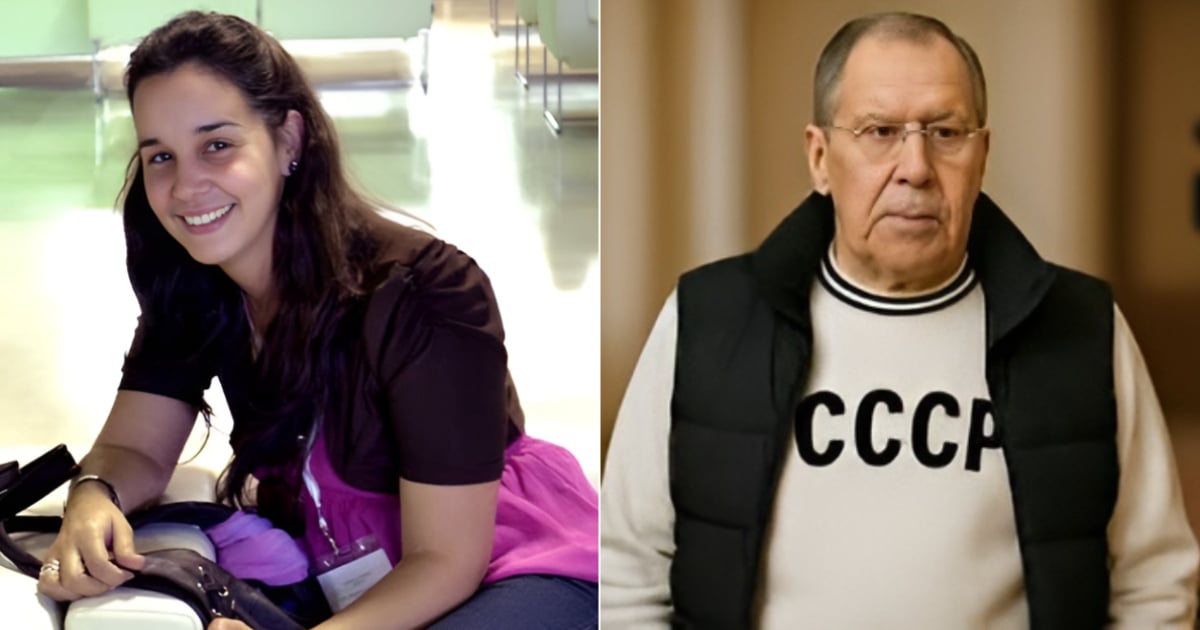
Leticia Martínez Hernández, the press chief for Cuban leader Miguel Díaz-Canel, has once again displayed her ideological alignment with the Cuban regime and her longing for the era of the "socialist bloc." Following the meeting between Vladimir Putin and Donald Trump in Alaska last Friday, the head of Palace communications took to social media to share an image of Russian Foreign Minister Sergey Lavrov wearing a shirt emblazoned with the Soviet acronym "СССР" (Union of Soviet Socialist Republics, USSR).
Accompanied by an emoji of admiration, the post goes beyond being a trivial anecdote, highlighting a concerning narrative: the normalization of symbols associated with totalitarianism and repression, as if they were badges of honor. Lavrov's photo, explicitly referencing the defunct Soviet Union, is no coincidence. It comes amid strengthening strategic ties between Moscow and Havana, which have grown since Russia's invasion of Ukraine, a former Soviet republic that gained independence on August 24, 1991.
"Russia and Cuba are on the right side of history," the Russian foreign minister stated earlier in May, discussing cooperation between Moscow and Havana. "I am pleased to note that, despite geographical distances, our nations are united by the close bonds of brotherhood proven over many years of cooperation in the spirit of strategic partnership." The Cuban regime has repeatedly avoided condemning Russia's aggression in international forums, often explicitly supporting the Kremlin's stance and blaming the West for the tensions.
For Martínez Hernández, the Russian minister's gesture is worthy of applause, reflecting the same imperialist and revanchist enthusiasm of Moscow's nostalgics. Lavrov, who has visited Havana several times since the war began, has expressed gratitude to the Cuban regime for refusing to join sanctions against Russia. Beyond diplomacy, Díaz-Canel's press chief showed her admiration by adding a heart emoji to Lavrov's fashion statement.
The Symbolic Weight of Soviet Insignia
The use of Soviet symbolism in Alaska—a territory historically contested by Moscow against the United States—sends a clear message: Russia has not forgotten its imperial ambitions or its narrative of power, now embraced by steadfast allies like the Cuban regime. This regime has enabled networks trafficking Cuban mercenaries to join the invasion of Ukraine.
Martínez Hernández is not merely a government spokesperson. As the communications head for the Cuban leader, she plays a propaganda role that extends beyond institutional protocol. Her history of publications includes attacks on government protesters—whom she has labeled as "selfish and insensitive"—and defenses of controversial official decisions, such as supporting the lavish Habano Festival amid widespread poverty.
These actions have drawn significant public criticism, even from former members of Cuba's State Security. The celebration of a Soviet-logo shirt by a key figure in presidential communications is not simply an exercise in nostalgia. It is a reaffirmation of the authoritarian, centralized, and repressive model that characterized both the USSR and Cuba’s current political system for decades. A model that, rather than solving current issues, perpetuates dependence, backwardness, and the suppression of freedoms.
A Dangerous Geopolitical Stance
Moreover, symbolically backing Russia in this context also represents a perilous geopolitical stance. At a time when Moscow is waging a widely condemned war of aggression, Cuba aligns itself, not only politically but morally, with a regime that violates sovereignties, persecutes dissidents, and restricts fundamental rights.
Celebrating symbols of an oppressive past while remaining silent on the massacres in Ukraine speaks volumes about the Cuban government's genuine commitment to justice, peace, and self-determination. The exaltation of Soviet symbolism by its communication apparatus is not just an ideological echo but a warning: the future they defend is the same as always. One where repression is the norm, dissent is punished, and propaganda is the official voice.
Understanding Cuba's Geopolitical Alignment
Why did the Cuban press chief praise Sergey Lavrov's Soviet-themed shirt?
The Cuban press chief praised Sergey Lavrov's Soviet-themed shirt as it aligns with her ideological beliefs and nostalgia for the socialist past, reflecting the strengthening ties between Russia and Cuba.
How has Cuba's stance on Russia's actions in Ukraine been perceived?
Cuba's refusal to condemn Russia's actions in Ukraine and its alignment with Moscow's stance have drawn criticism for supporting a regime that violates international norms and suppresses dissent.