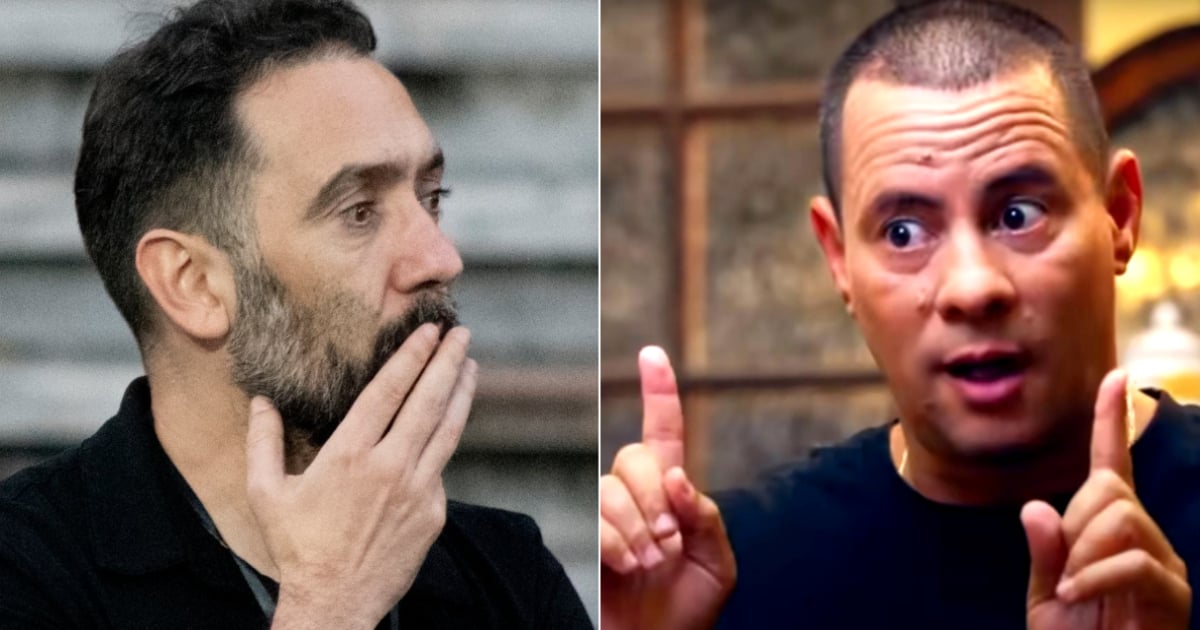
The recent interview with Israel Rojas on La Joven Cuba, where the Buena Fe leader discussed reconciliation, dialogue, and the possibility of pardoning some 11J prisoners, not only sparked widespread criticism and skepticism among Cuban civil society but also prompted a swift reaction from the regime's ideological apparatus. This response came through an article on Cubadebate penned by Spanish communist Carlos González Penalva, who acts as a gleeful spokesperson for the officialist dogma, masquerading as a political analyst and expert in communication and social networks.
Under the title 'The Trap of Equidistance,' the piece attempts to discredit La Joven Cuba while issuing a veiled warning to figures like Rojas and any attempt at dialogue with sectors outside the control of the Communist Party. The ideological operation is clear: although Rojas did not directly challenge the regime, his mere appearance in a critical and independent space was seen as a dangerous concession. González Penalva, in the name of revolutionary purity, reminds us that even nuances will be closely monitored.
A Controlled Illusion of Openness
The contradiction between Israel Rojas's superficially conciliatory tone and Cubadebate's dogmatic reaction is no accident but part of a broader strategy by the Cuban regime to maintain its fierce grip on public discourse. By simulating an "openness" to debate on social networks and independent platforms, the regime aims to prolong its decades-long dominance. Both narratives, though seemingly opposed, serve complementary roles: Rojas presents a more amiable and "dialogue-friendly" face, useful for polishing the government's image in a society tired of repression, while González Penalva, from Cubadebate, acts as the stern voice defining the limits of permissible dissent.
The Fallacy of Equidistance
With poorly digested Gramscian rhetoric, González Penalva accuses La Joven Cuba of staging a false symmetry between "victim and aggressor" and being part of a supposed international strategy to strip the Cuban public space of its "revolutionary" content. The key term in his attack is "equidistance," which he defines as a form of "soft counterrevolution," cloaked in pluralism and tolerance, yet functional in dismantling socialism.
This discourse is profoundly authoritarian: it doesn't challenge the overt enemy but targets nuance, doubt, and conversation. For González Penalva, criticism is only legitimate if it occurs "within the revolutionary process." And by "within," he does not mean a cultural or identity belonging but a political submission to the Communist Party.
The External Enemy Strategy
As is common in officialist discourse, the article relies on the theory of an external enemy to discredit anything not under its control. González Penalva accuses La Joven Cuba of receiving financial support from the Norwegian Embassy and being part of a global network designed by the U.S. and its allies to foster an "alternative civil society" that promotes capitalist restoration on the island. He mentions the NED, USAID, and "bourgeois liberalism" as part of the enemy machinery.
This type of rhetoric deliberately ignores the real reasons for popular discontent: repression, hunger, lack of freedom, economic collapse, and mass emigration. There is no mention in his article of the 11J prisoners, Decree Law 35, or the numerous violations of freedom of expression and systematic censorship of independent media. Instead, embassies and Gramsci are discussed.
The Illusion of Tolerant Openness
Both Israel Rojas's statements and Cubadebate's "militant" response fit into a strategy of simulation. The regime needs to appear as if it listens, dialogues, debates, and allows dissent, but only if it occurs on its terms, under its scrutiny, and with actors functional to its narrative. If not, the apparatus reacts, as it did this time, through its network of foreign ideologues.
Carlos González Penalva writes not just as a militant but as part of a communication structure that advises, justifies, and shields the discourse of Miguel Díaz-Canel's regime. His insistence on warning against "the carefully staged scene" reveals that even the most innocuous gestures, like an interview, can be perceived as threats if they escape the official script.
When power fears dialogue, it is no longer defending an idea or a social project: it is defending its interests and continuity at any cost.
Key Questions on Cuban Political Dynamics
What was the reaction to Israel Rojas's interview on La Joven Cuba?
The interview sparked criticism and skepticism among Cuban civil society and prompted a swift reaction from the regime's ideological apparatus, particularly through an article on Cubadebate.
How does the Cuban regime perceive dialogue attempts with independent sectors?
The regime views dialogue attempts with independent sectors as dangerous concessions, as seen in their reaction to Israel Rojas's appearance in a critical and independent space.
What is the significance of the term "equidistance" in the article?
"Equidistance" is used to describe a form of "soft counterrevolution," suggesting a false balance that undermines the revolutionary socialist agenda by cloaking itself in pluralism and tolerance.